Yarn Weight Guide
Yarn weights from lace to jumbo, with recommended hook/needle sizes and what to make with each weight.
Yarn labels use names like DK, worsted and bulky, but those names hide the thickness that decides drape, gauge and how much yarn a project needs. This guide maps the standard Craft Yarn Council weights, their common names, and the hook or needle that suits each, so you can substitute yarn with confidence.
Quick-Reference Table
The full data from this cheat sheet, right on the page.
| Weight | Common names | Hook (approx.) | Needles (approx.) | Best for |
|---|---|---|---|---|
| 0 — Lace | Lace, fingering (light) | 1.6–2.25 mm | 1.5–2.25 mm | Shawls, doilies, lacework |
| 1 — Super Fine | Fingering, sock, baby | 2.25–3.5 mm | 2.25–3.25 mm | Socks, baby clothes, light shawls |
| 2 — Fine | Sport, baby | 3.5–4.5 mm | 3.25–3.75 mm | Light sweaters, baby blankets |
| 3 — Light | DK, light worsted | 4.5–5.5 mm | 3.75–4.5 mm | Sweaters, scarves, hats |
| 4 — Medium | Worsted, aran, afghan | 5.5–6.5 mm | 4.5–5.5 mm | Blankets, sweaters, hats — the all-rounder |
| 5 — Bulky | Chunky, craft, rug | 6.5–9 mm | 5.5–8 mm | Quick blankets, chunky scarves, rugs |
| 6 — Super Bulky | Super chunky, roving | 9–15 mm | 8–12.75 mm | Fast blankets, oversized scarves |
| 7 — Jumbo | Jumbo, roving | 15 mm+ | 12.75 mm+ | Arm knitting, giant blankets |
Printable Sheet Preview
High-Contrast Layout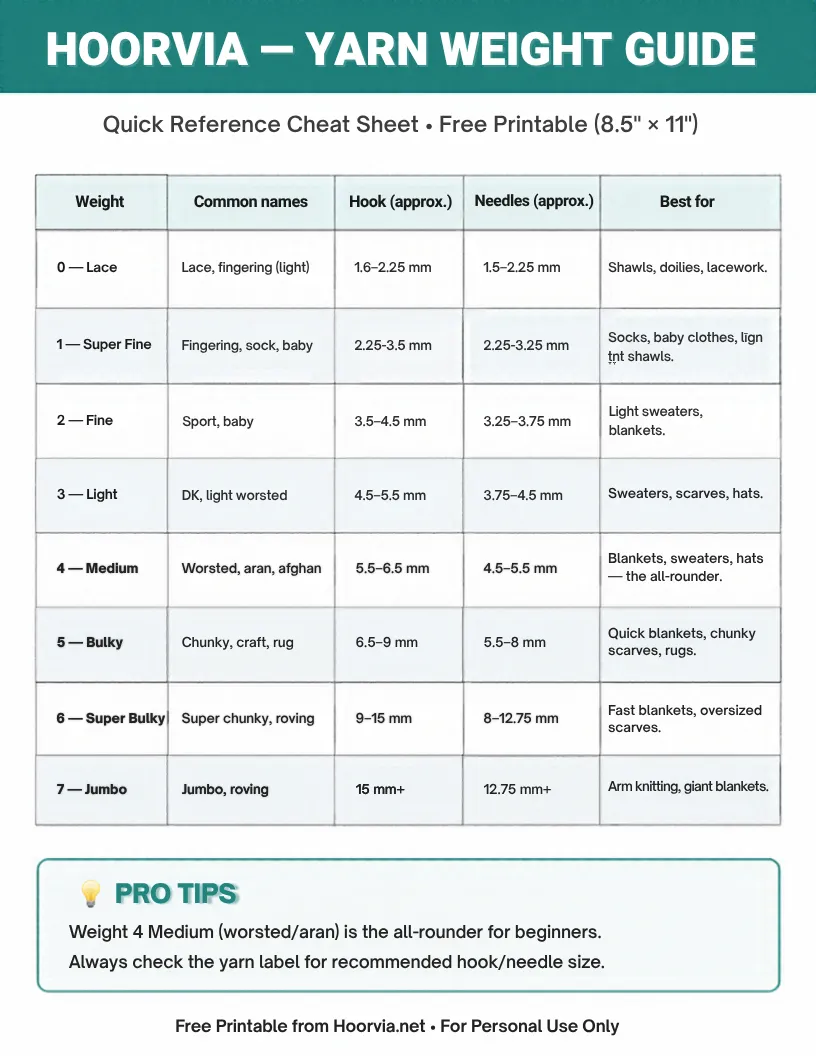
Download Your Free Printable Sheet
Download the printable PDF below. It is the same sheet shown in the preview above, ready to print on US Letter or A4 — open it and choose Print, with Scale set to Fit to Page.
💡 Pro Printing Tip: In your printer settings, set Scale to “Fit to Printable Area” and enable “Background Graphics” for color headers.
How to Print & Use This Chart
Print on US Letter or A4 and keep it with your yarn stash or pattern binder, so you can check a substitution before you buy. Use the print dialog’s “Save as PDF” option for a PDF copy in Letter or A4, and laminate it if it will live in a craft bag with yarn and hooks. A useful habit is to write the yarns you actually own next to each weight on the printed sheet — that turns a generic guide into a personal stash index, and stops you buying a fourth skein of worsted when what you needed was DK.
When substituting, match the weight category and the gauge on the label first, not just the brand name, because “worsted” from one company can be slightly thicker than another’s. Buy one extra skein for large projects, especially for dye-lot-sensitive colours, and check that all skeins share the same dye lot before you start. Make a gauge swatch in the stitch pattern you will use, not just stockinette, and wash it the way the finished item will be washed — some yarns grow or shrink. For wearables, consider drape: a bulky yarn makes a cosy blanket but a stiff sweater, while a light DK drapes better for garments. If you are mixing weights in one project, do it deliberately for texture, not by accident, and note the combination on this sheet for next time.
Frequently Asked Questions (FAQs)
What is the most versatile yarn weight?▼
Medium / worsted (weight 4). It suits blankets, sweaters, hats and scarves, and the widest range of patterns uses it.
Can I substitute DK for worsted?▼
You can, but gauge and drape will change. Swatch first and adjust hook/needle size, or the finished size will be off.
Why does my sweater feel stiff?▼
Often the yarn is too heavy for the pattern, or the hook/needle is too small. Go up a size or choose a lighter weight.
What do the numbers 0–7 mean?▼
They are the Craft Yarn Council standard weights, from 0 (lace, finest) to 7 (jumbo, thickest). Use them to compare yarns across brands.