Blood Sugar Log Sheet Printable
A simple blood sugar log with date, time, before/after meal readings and notes — printable for daily or weekly tracking.
People who monitor blood sugar need a log that is quick to fill in and easy to show a clinician. This sheet records date, time, whether the reading was before or after a meal, the result, and a short note about food, activity or symptoms, so patterns — not single readings — become visible over weeks.
Quick-Reference Table
The full data from this cheat sheet, right on the page.
| Date | Time | Before / After Meal | Reading | Notes (food, activity, symptoms) |
|---|---|---|---|---|
| ___ / ___ / ___ | ___ : ___ | Before / After | ||
| ___ / ___ / ___ | ___ : ___ | Before / After | ||
| ___ / ___ / ___ | ___ : ___ | Before / After | ||
| ___ / ___ / ___ | ___ : ___ | Before / After | ||
| ___ / ___ / ___ | ___ : ___ | Before / After | ||
| ___ / ___ / ___ | ___ : ___ | Before / After | ||
| ___ / ___ / ___ | ___ : ___ | Before / After | ||
| ___ / ___ / ___ | ___ : ___ | Before / After | ||
| ___ / ___ / ___ | ___ : ___ | Before / After | ||
| ___ / ___ / ___ | ___ : ___ | Before / After |
Printable Sheet Preview
High-Contrast Layout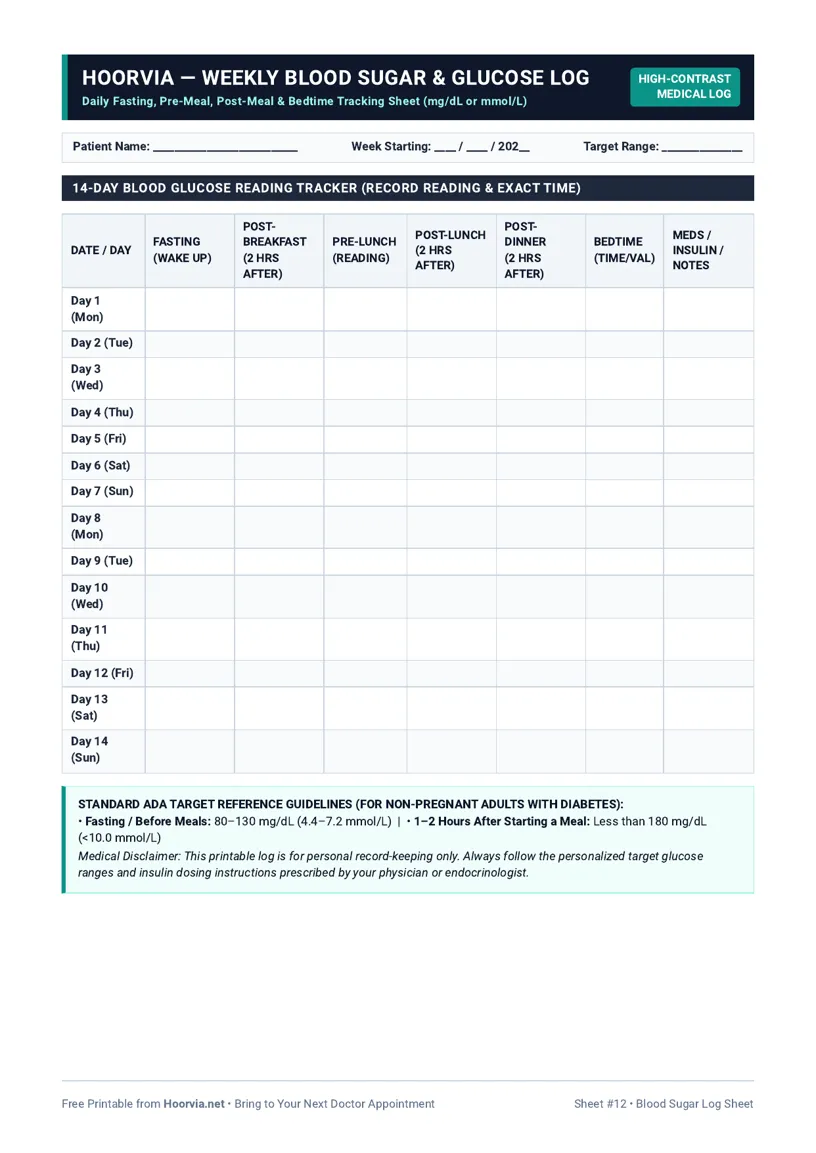
Download Your Free Printable Sheet
Download the printable PDF below. It is the same sheet shown in the preview above, ready to print on US Letter or A4 — open it and choose Print, with Scale set to Fit to Page.
💡 Pro Printing Tip: In your printer settings, set Scale to “Fit to Printable Area” and enable “Background Graphics” for color headers.
How to Print & Use This Chart
Print on US Letter or A4 and keep the log with your meter, in a notebook, or on the fridge — wherever testing actually happens. In the print dialog, choose “Save as PDF” for a PDF copy and set Letter or A4 for your paper. Print a stack at once, because a log that runs out mid-week often means a week of readings is lost, and patterns are what matter most. A binder or folder for completed logs makes it easy to hand a clinician several weeks at once, instead of searching through loose sheets or phone photos.
Record each reading straight away with the time and whether it was before or after a meal, plus a brief note if you ate something unusual, exercised, felt unwell, or missed medication. That context turns a list of numbers into useful information: a clinician can see whether highs follow particular meals or lows follow activity, rather than guessing. Do not judge a single reading in isolation, and do not change medication doses based on this sheet alone — discuss patterns with your clinician or diabetes educator. If you notice repeated very high or very low readings, symptoms like confusion, sweating or shakiness, or you are unsure what to do, seek medical advice promptly. Store logs privately, as they are personal health information, and keep the meter’s own memory as a backup in case a paper sheet is lost.
Frequently Asked Questions (FAQs)
What is a normal blood sugar range?▼
It varies by person, age, medication and whether you are fasting or after a meal. Use the target range your clinician set for you, not a generic chart.
Should I log before or after meals?▼
Log both when your clinician asks for them, and always note which one it was. Without that label, a reading is hard to interpret.
What if I get a very low reading?▼
Follow your clinician’s hypoglycaemia plan immediately and seek help if symptoms are severe or do not improve. Do not wait to fill in the log first.
Can I use this log instead of my meter’s memory?▼
Use both. The paper log adds context (meals, symptoms); the meter memory is a backup if a sheet is lost.