Math & Logic Symbols Chart: Printable Reference Guide
Math and logic symbols look like a secret code the first time you meet them — a ∀ here, an ∈ there — and most students and developers just memorize shapes without ever learning what each symbol actually says. That guesswork fails the moment you read a proof, a set-theory textbook, or a technical spec, where one misunderstood symbol flips the meaning of an entire statement. A reliable reference turns the code back into plain language: each symbol has a name, one clear meaning, and a pattern you can recognize at a glance. This printable math and logic symbols chart covers fourteen of the most-used symbols across sets, logic, and algebra, with the name, meaning, and a concrete example for each. Scan the live table below the next time a formula looks hostile, or print the sheet below to keep beside your textbook.
Quick-Reference Table
The full data from this cheat sheet, right on the page.
| Symbol | Name | Meaning | Example |
|---|---|---|---|
| ∀ | For All | Universal quantifier: every member satisfies the condition | ∀x, x + 0 = x |
| ∃ | There Exists | Existential quantifier: at least one member satisfies it | ∃x such that x² = 4 |
| ∈ | Element Of | Membership: the item belongs to the set | 3 ∈ {1, 2, 3} |
| ∉ | Not an Element Of | Non-membership: the item is outside the set | 5 ∉ {1, 2, 3} |
| ⊆ | Subset | Every element of the left set is also in the right set | {1, 2} ⊆ {1, 2, 3} |
| ∪ | Union | All elements from both sets combined | {1, 2} ∪ {2, 3} = {1, 2, 3} |
| ∩ | Intersection | Only the elements found in both sets | {1, 2} ∩ {2, 3} = {2} |
| ∧ | Logical AND | Conjunction: both statements must be true | p ∧ q is true only if both hold |
| ∨ | Logical OR | Disjunction: at least one statement is true | p ∨ q is true if either holds |
| ¬ | Logical NOT | Negation: flips true to false | ¬p is true when p is false |
| → | Implies | Conditional: if the left holds, the right follows | p → q: p true forces q true |
| ↔ | If and Only If | Biconditional: both sides always match | p ↔ q is true when both agree |
| ∴ | Therefore | Marks the conclusion of an argument | All men are mortal ∴ Socrates is mortal |
| ∑ | Summation | Adds a sequence of terms together | ∑(1 to n) i = n(n+1)/2 |
How to Use This Chart
Pin this chart where you work: it packs 14 entries and 4 columns (Symbol, Name, Meaning, Example) into one printable page, built for quick lookups.
Scan down the Symbol column to your item, then read across for Name, Meaning, Example.
Example: for ∀, the chart gives Name of For All.
- Compare values down a single column to spot the pattern before you commit to a choice.
- When two rows look close, the last column usually breaks the tie.
- Print it once and keep it where you work — that's the whole point of a cheat sheet.
💡 Quick Tips
Read Symbols as Words: ∀x is read 'for all x' and ∃x as 'there exists an x'. Saying the sentence out loud is the fastest way to make a proof readable.
Sets vs. Logic: ∈ and ⊆ talk about sets; ∧, ∨, and ¬ talk about statements. Mixing the two families is the most common beginner error.
Draw It Out: Subset and union relationships click faster as Venn diagrams. Sketch two overlapping circles before wrestling with the symbols.
Frequently Asked Questions
What is the difference between ∀ and ∃?
∀ means 'for all' — a claim about every member of a set — while ∃ means 'there exists' — a claim that at least one member satisfies it. ∀x P(x) says every x works; ∃x P(x) says at least one does. Swapping them changes a proof's meaning entirely.
What does the ∈ symbol mean in math?
∈ means 'is an element of' — 3 ∈ {1, 2, 3} says 3 belongs to the set. Its negation ∉ means 'is not an element of'. You'll see it constantly in set theory, probability, and programming documentation about collections.
How do you read a statement like A ⊆ B?
Read it as 'A is a subset of B' — every element of A is also in B. If A also has fewer elements, you can write A ⊂ B, the proper subset, meaning B contains something A doesn't.
Printable Sheet Preview
High-Contrast Layout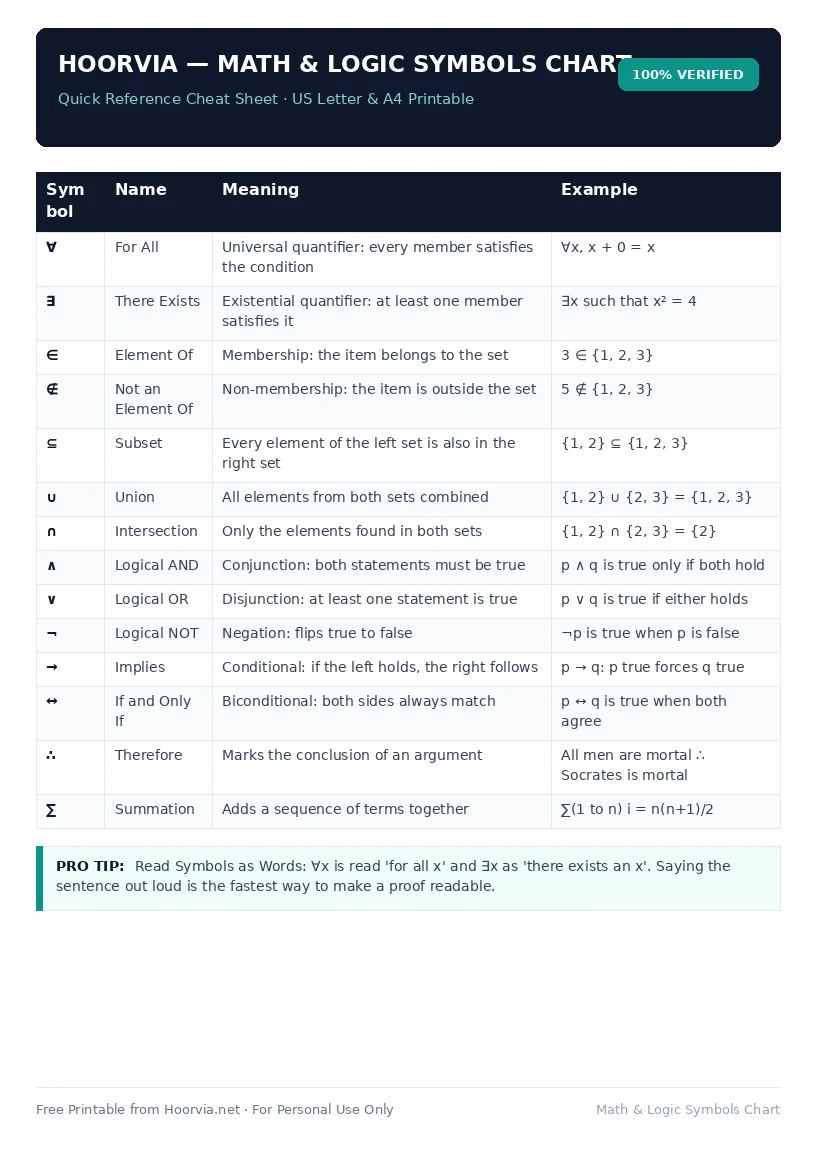
Download Your Free Printable Sheet
Download the printable PDF below. It is the same sheet shown in the preview above, ready to print on US Letter or A4 — open it and choose Print, with Scale set to Fit to Page.
💡 Pro Printing Tip: In your printer settings, set Scale to “Fit to Printable Area” and enable “Background Graphics” for color headers.