Monthly Bill Organizer Chart: Printable Household Budget Tracker
Missing a single bill costs more than the bill itself: late fees stack, credit scores drop, and one forgotten subscription keeps charging for months. Most people know roughly what they owe, but nobody can recite twelve due dates from memory — and the bills that slip through are always the irregular ones like quarterly insurance or annual property tax. A monthly bill organizer turns that mental juggling into one visible page: every category you pay, when it typically lands, what share of your income it should take, and which ones are safe to automate. Consult the live reference table below to audit your own bills against the guidelines, or print the sheet below and check each row off as you pay it — the quickest way to never pay a late fee again.
Quick-Reference Table
The full data from this cheat sheet, right on the page.
| Bill Category | Typical Due Window | Share of Net Income | Autopay Advice | Record to Keep |
|---|---|---|---|---|
| Housing (rent / mortgage + tax) | 1st of month | 25–28% | Semi-auto — review escrow statements yearly | Escrow and tax statements |
| Essential utilities (power, water, gas) | 1st–15th | 5–8% | Auto with levelized budget billing | Monthly kWh / therm usage |
| Internet & mobile phones | Fixed billing date | 2–4% | Auto on a rewards credit card | Annual plan-price audit |
| Auto loan / transit costs | Fixed billing date | 10–15% incl. insurance | Auto for the loan, manual for fuel | Loan statements, fuel log |
| Insurance (health, auto, renters) | Monthly or quarterly | 5–10% | Auto — lapses are expensive | Policy declarations pages |
| Groceries & household supplies | Weekly | 10–15% | Manual — review each trip | Weekly spending total |
| Childcare / school costs | Monthly or term | Varies | Auto if fixed monthly | Payment receipts, tax docs |
| Subscriptions & memberships | Staggered monthly | Under 2% | Manual — audit every 3 months | List of active subscriptions |
| Debt payments (cards, loans) | Multiple dates | Under 20% total | Auto at least the minimum | Balance and rate per account |
| Savings & emergency fund | Payday | 10–20% | Auto-transfer on payday | Monthly balance snapshot |
| Medical, dental & prescriptions | Irregular | 2–5% | Manual — verify each bill | EOBs and receipts |
| Taxes, HOA & annual fees | Quarterly / annual | 2–5% | Calendar reminder, manual pay | Annual statements |
How to Use This Chart
Pin this chart where you work: it packs 12 entries and 5 columns (Bill Category, Typical Due Window, Share of Net Income, Autopay Advice, Record to Keep) into one printable page, built for quick lookups.
Scan down the Bill Category column to your item, then read across for Typical Due Window, Share of Net Income, Autopay Advice, Record to Keep.
Example: for Housing (rent / mortgage + tax), the chart gives Typical Due Window of 1st of month.
- Compare values down a single column to spot the pattern before you commit to a choice.
- When two rows look close, the last column usually breaks the tie.
- Print it once and keep it where you work — that's the whole point of a cheat sheet.
💡 Quick Tips
Pay Yourself First: Move savings out on payday before bills — money left over at month-end rarely gets saved.
Audit Quarterly: Subscriptions and insurance creep upward silently; a 15-minute quarterly review catches them.
One Late Fee Is One Too Many: Even a single 30-day late payment dents your credit score — set calendar alerts for manual bills.
Frequently Asked Questions
What percentage of income should bills take?
A common target is the 50/30/20 rule: about 50% of take-home pay for needs (housing, utilities, groceries, transport), 30% for wants, and 20% for savings and debt payoff. If needs exceed 50%, trimming subscriptions and refinancing debt are the usual first moves.
Which bills should I put on autopay?
Automate fixed, penalty-prone bills: loans, insurance, and utilities with levelized billing. Keep variable bills like credit cards on semi-automatic (auto-pay the minimum, review the statement, then pay the rest manually) so billing errors never slip through.
How do I organize bills that are due quarterly or annually?
Divide each irregular bill by 12 and 'bill yourself' monthly into a separate savings bucket — e.g., a $1,200 annual insurance premium becomes $100 a month. When the real bill arrives, the money is already sitting there.
Printable Sheet Preview
High-Contrast Layout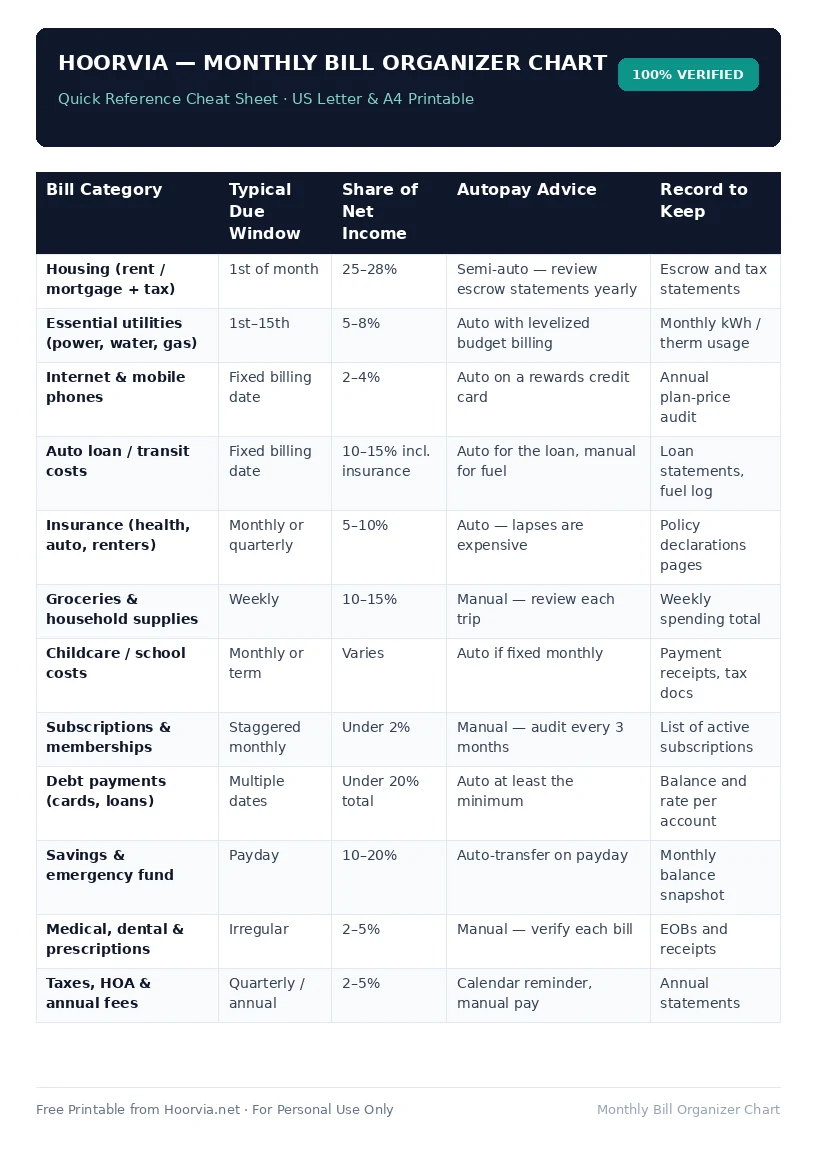
Download Your Free Printable Sheet
Download the printable PDF below. It is the same sheet shown in the preview above, ready to print on US Letter or A4 — open it and choose Print, with Scale set to Fit to Page.
💡 Pro Printing Tip: In your printer settings, set Scale to “Fit to Printable Area” and enable “Background Graphics” for color headers.