Mood Log Chart: Printable Daily Mental Health Tracker
Feelings are terrible historians — after a bad week, everything feels like it has always been bad, and after a good day, the hard days vanish from memory. Therapists know this, which is why cognitive behavioral therapy starts with one tool: a daily mood log. Tracking your mood, sleep, triggers, and coping habits for a few weeks reveals the patterns your memory hides — that your low moods always follow poor sleep, or that Sunday dread is really about Monday's meeting. You don't need an app with notifications and streaks; one printed page and two minutes twice a day works just as well. This chart breaks the habit into twelve simple check-ins with the scale to use for each. Consult the live reference table below, or print the sheet below and start tonight.
Quick-Reference Table
The full data from this cheat sheet, right on the page.
| Check-In Moment | What to Log | Scale / Format | Why It Matters |
|---|---|---|---|
| Morning mood | Overall mood on waking | 1–10 (1 = awful, 10 = great) | Sets a baseline; reveals how sleep quality shapes your day |
| Evening mood | Overall mood before bed | 1–10 | The gap between morning and evening shows what the day did to you |
| Sleep hours | Hours slept + quality | Hours + Poor / OK / Good | Poor sleep is the single biggest predictor of next-day low mood |
| Energy level | Physical and mental energy | 1–10 | Energy and mood track closely — low energy days need less load |
| Stress / anxiety | Current stress or anxiety level | 1–10 | Spots buildup early, before stress becomes a crisis |
| Trigger event | What happened before a mood dip | Short note | Naming triggers lets you plan around them next time |
| Positive moment | Best moment of the day | Short note | Trains your brain to notice good events, not just bad ones |
| Coping strategy used | What you did to feel better | Short note | Builds a personal menu of strategies that actually work |
| Physical activity | Exercise or movement | Minutes + type | Even a 10-minute walk reliably lifts mood for hours |
| Social connection | Meaningful interaction | Yes / No + who | Connection protects against low mood — isolation is a warning sign |
| Caffeine & alcohol | Stimulants and depressants | Drinks + time | Caffeine after noon wrecks sleep; alcohol mimics and worsens anxiety |
| Overall day rating | The day as a whole | 1–10 + one word | One glance back per week reveals patterns invisible day to day |
How to Use This Chart
Pin this chart where you work: it packs 12 entries and 4 columns (Check-In Moment, What to Log, Scale / Format, Why It Matters) into one printable page, built for quick lookups.
Scan down the Check-In Moment column to your item, then read across for What to Log, Scale / Format, Why It Matters.
Example: for Morning mood, the chart gives What to Log of Overall mood on waking.
- Compare values down a single column to spot the pattern before you commit to a choice.
- When two rows look close, the last column usually breaks the tie.
- Print it once and keep it where you work — that's the whole point of a cheat sheet.
💡 Quick Tips
Two Minutes, Twice a Day: Log at breakfast and bedtime — speed beats detail; a simple 1–10 scale you fill in wins over a perfect form you skip.
Watch the Sleep Link: After two weeks, compare sleep rows against mood rows — most people see the pattern immediately.
Share With Your Therapist: A printed log gives your therapist data instead of guesses — bring it to sessions.
Frequently Asked Questions
How long before a mood log shows patterns?
Most people see their first patterns within two to three weeks of daily logging — usually the sleep–mood link first. Give it a full month before drawing conclusions, since one rough week can be noise rather than a real pattern.
Can a mood log help with anxiety or depression?
Yes — mood logs are a core CBT technique and research shows self-monitoring itself can reduce symptoms, because it replaces vague dread with specific, solvable triggers. But a log is a tool, not treatment: persistent low mood deserves professional help.
Should I use an app or a paper mood log?
Whichever you will actually use. Apps add reminders and charts; paper has no subscriptions, no notifications, and no data going anywhere. This printable chart is designed for the two-minute, twice-a-day habit that makes either format work.
Printable Sheet Preview
High-Contrast Layout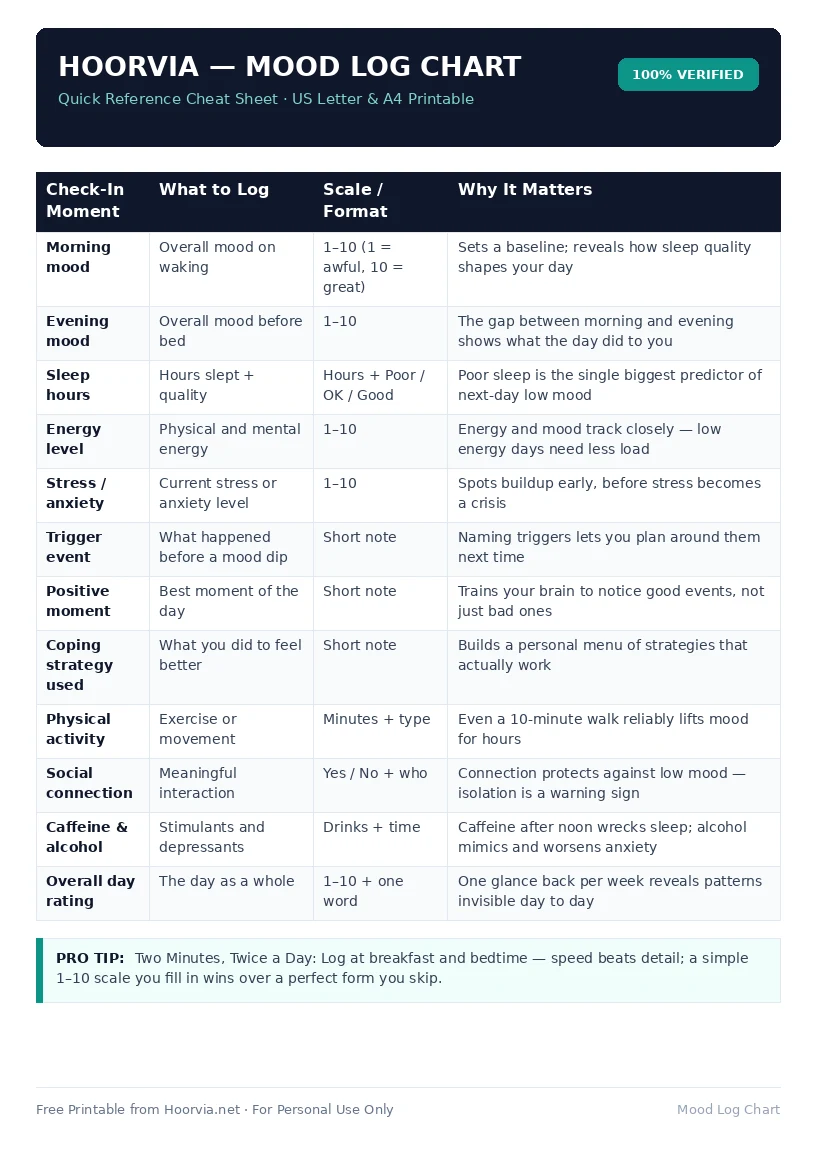
Download Your Free Printable Sheet
Download the printable PDF below. It is the same sheet shown in the preview above, ready to print on US Letter or A4 — open it and choose Print, with Scale set to Fit to Page.
💡 Pro Printing Tip: In your printer settings, set Scale to “Fit to Printable Area” and enable “Background Graphics” for color headers.