Morning & Evening Routine Chart: Printable Daily Rhythm Planner
Most routines fail before noon because they live in your head instead of on paper: the alarm snoozes, the phone wins, and the evening dissolves into scrolling until sleep arrives by accident. Research on habit formation is clear that timing matters — a routine anchored to fixed time slots survives busy days because it removes the decision about what to do next. This printable chart maps a complete day in twelve blocks: six morning slots that protect your peak focus hours (light exposure, movement, planning, deep work) and six evening slots that power down stress and protect sleep (a work shutdown, family dinner, digital sunset, and a real bedtime). Consult the live reference table below to tune the times to your own day, or print the sheet below and check each block off — the fastest way to find out which parts of your day actually need fixing.
Quick-Reference Table
The full data from this cheat sheet, right on the page.
| Routine Block | Time Slot | Activity | Why It Works |
|---|---|---|---|
| Wake & Hydrate | 6:00–6:15 | Get up on the first alarm, drink a full glass of water, open the curtains | Morning light exposure resets your circadian clock so you feel alert faster |
| Phone-Free Start | 6:15–6:30 | Fifteen minutes with no screens — coffee, stretch, or simply sit | Protects your focus from other people's agendas before the day begins |
| Morning Movement | 6:30–7:00 | Twenty to thirty minutes of walking, stretching, or a workout | Morning exercise raises energy and mood for the rest of the day |
| Cool Finish Shower | 7:00–7:10 | End your shower with a cool rinse for the last minute | Cool water triggers alertness and leaves you feeling fully awake |
| Plan the Day | 7:10–7:20 | Write down your top three priorities on paper | Deciding once in the morning beats deciding all day under pressure |
| Deep Work Block | 7:20–9:00 | Tackle the hardest task first with phone on silent | Willpower and focus peak in the morning — spend them on what matters |
| Work Shutdown | 17:30–18:00 | Close open loops, note tomorrow's first task, shut the laptop | A clear shutdown ritual lets your brain truly stop working |
| Dinner & Family | 18:00–19:00 | Eat at a table, away from screens, with people you like | Shared meals lower stress and mark the day as officially over |
| Evening Walk | 19:00–19:30 | A relaxed walk around the block after dinner | Light movement aids digestion and drops cortisol after a tense day |
| Review & Journal | 19:30–19:45 | Write three wins and one lesson from the day | Captures progress your brain would otherwise forget by morning |
| Digital Sunset | 21:00 | Screens off — phone charges outside the bedroom | Blue light delays melatonin; removing the source is easier than resisting it |
| Wind Down & Sleep | 21:30–22:00 | Read a book, breathe slowly, lights out | Seven to nine hours is the adult target — consistency beats a perfect bedtime |
How to Use This Chart
Pin this chart where you work: it packs 12 entries and 4 columns (Routine Block, Time Slot, Activity, Why It Works) into one printable page, built for quick lookups.
Scan down the Routine Block column to your item, then read across for Time Slot, Activity, Why It Works.
Example: for Wake & Hydrate, the chart gives Time Slot of 6:00–6:15.
- Compare values down a single column to spot the pattern before you commit to a choice.
- When two rows look close, the last column usually breaks the tie.
- Print it once and keep it where you work — that's the whole point of a cheat sheet.
💡 Quick Tips
Anchor to Existing Habits: Link each block to something you already do, like stretching while coffee brews, so routines build on autopilot.
Start with Three Blocks: Install the wake time, phone-free start, and digital sunset first, then layer the rest in.
Protect the Bookends: The morning's first hour and night's last hour decide the quality of everything between them.
Frequently Asked Questions
What is the best morning routine for productivity?
Wake at a fixed time, get daylight and water, move your body for twenty minutes, then work on your hardest task before checking email or messages. Most research agrees the sequence matters more than the specific activities: light, movement, planning, then deep work.
How long does it take to build a daily routine?
Habit studies show simple routines solidify in about two to eight weeks with daily repetition, and complex ones take longer. Anchor each new block to an existing habit — like journaling right after dinner — and track it on a printed chart to keep the streak visible.
What should an evening routine include?
A shutdown ritual for work, a real dinner away from screens, light movement, a digital sunset about an hour before bed, and a fixed lights-out time. The single highest-impact change is charging your phone outside the bedroom.
Printable Sheet Preview
High-Contrast Layout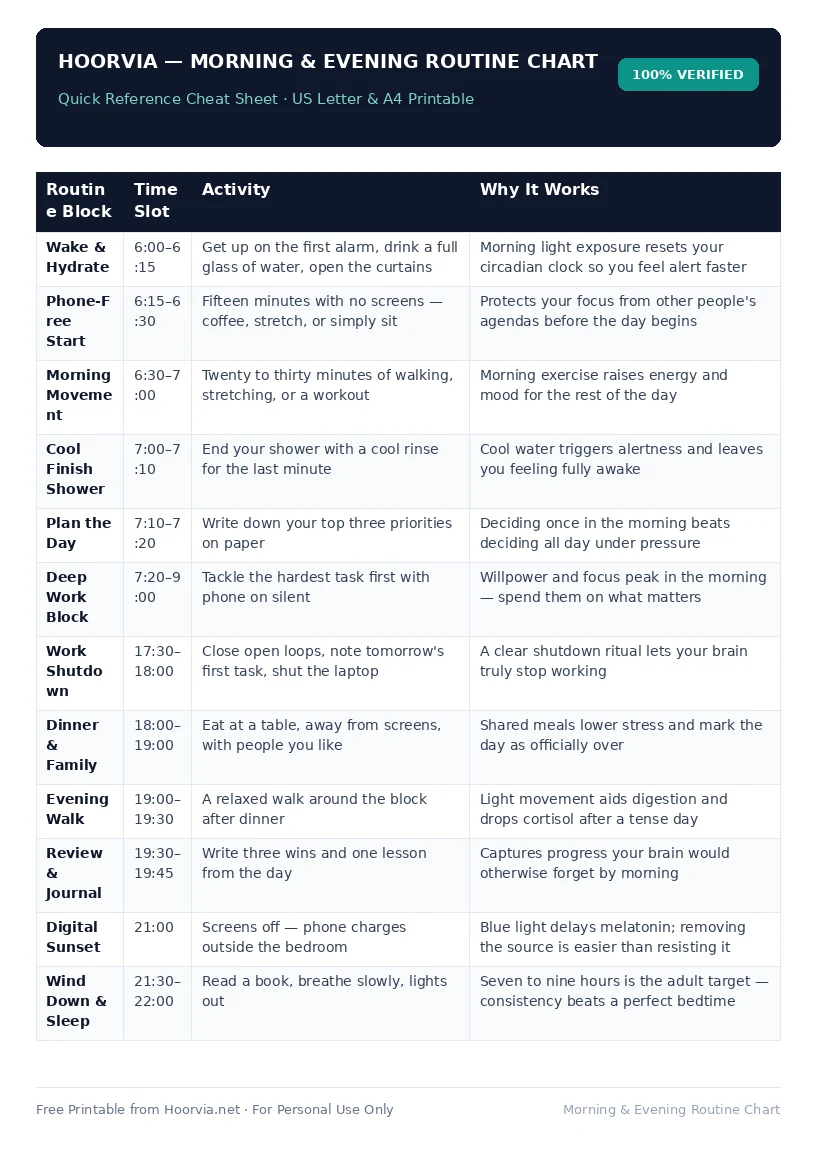
Download Your Free Printable Sheet
Download the printable PDF below. It is the same sheet shown in the preview above, ready to print on US Letter or A4 — open it and choose Print, with Scale set to Fit to Page.
💡 Pro Printing Tip: In your printer settings, set Scale to “Fit to Printable Area” and enable “Background Graphics” for color headers.