Multiplication Grid 1–12 & 1–20: Printable Times Table Chart
Multiplication facts are the bottleneck of all later math: if 7×8 still takes ten seconds of finger-counting, long division, fractions, and algebra all grind to a halt. Guessing from partial memory is worse than not knowing, because a wrong fact practiced a hundred times becomes a habit. What kids actually need is a single reliable reference they can check in seconds — one that builds the pattern sense of skip-counting, squares, and the 12s and 20s they meet in measurements and money. This printable chart gives a quick-lookup multiplication grid for the numbers 1–12 with ×5, ×10, ×12, ×20, and square values in each row. Consult the live reference table below during homework, or print the sheet below for the desk or fridge — a checked fact today becomes an automatic fact next month.
Quick-Reference Table
The full data from this cheat sheet, right on the page.
| Number | × 5 | × 10 | × 12 | × 20 | Square (n²) |
|---|---|---|---|---|---|
| 1 | 5 | 10 | 12 | 20 | 1 |
| 2 | 10 | 20 | 24 | 40 | 4 |
| 3 | 15 | 30 | 36 | 60 | 9 |
| 4 | 20 | 40 | 48 | 80 | 16 |
| 5 | 25 | 50 | 60 | 100 | 25 |
| 6 | 30 | 60 | 72 | 120 | 36 |
| 7 | 35 | 70 | 84 | 140 | 49 |
| 8 | 40 | 80 | 96 | 160 | 64 |
| 9 | 45 | 90 | 108 | 180 | 81 |
| 10 | 50 | 100 | 120 | 200 | 100 |
| 11 | 55 | 110 | 132 | 220 | 121 |
| 12 | 60 | 120 | 144 | 240 | 144 |
How to Use This Chart
Pin this chart where you work: it packs 12 entries and 6 columns (Number, × 5, × 10, × 12, × 20, Square (n²)) into one printable page, built for quick lookups.
Scan down the Number column to your item, then read across for × 5, × 10, × 12, × 20, Square (n²).
Example: for 1, the chart gives × 5 of 5.
- Compare values down a single column to spot the pattern before you commit to a choice.
- When two rows look close, the last column usually breaks the tie.
- Print it once and keep it where you work — that's the whole point of a cheat sheet.
💡 Quick Tips
Learn the Squares First: The twelve squares (1, 4, 9, 16, 25 … 144) anchor the grid — nearby facts sit one row away.
Use ×5 as a Bridge: Every multiple of five ends in 0 or 5, so 7×6 is 7×5 plus 7 — find the nearest five and adjust.
Skip-Count Aloud: Count 12, 24, 36 aloud while pointing at each row — hearing the rhythm beats silent reading.
Frequently Asked Questions
What is the fastest way to memorize multiplication facts?
Practice a few facts at a time with mixed recall — flashcards, timed quizzes, or skip-counting games — instead of reading the table top to bottom. Start with easy rows (×2, ×5, ×10), then squares, then the tricky 7×8. Short daily drills on a printed chart beat one long session.
Why do schools teach multiplication up to 12?
Twelve is the biggest highly composite small number — it divides evenly by 1, 2, 3, 4, and 6, which makes fractions, dozens, inches, and clock math natural. The 12×12 table captures these patterns, while the ×20 column covers money, measurements, and the twenties kids meet in real life.
Should kids learn multiplication by memorizing or understanding?
Both — understanding comes first through groups and arrays, then memorization makes the facts automatic. A child who knows 6×4 as ‘six groups of four’ and has also drilled it recalls the answer instantly. Use the chart to check answers while learning, then print it for timed practice.
Printable Sheet Preview
High-Contrast Layout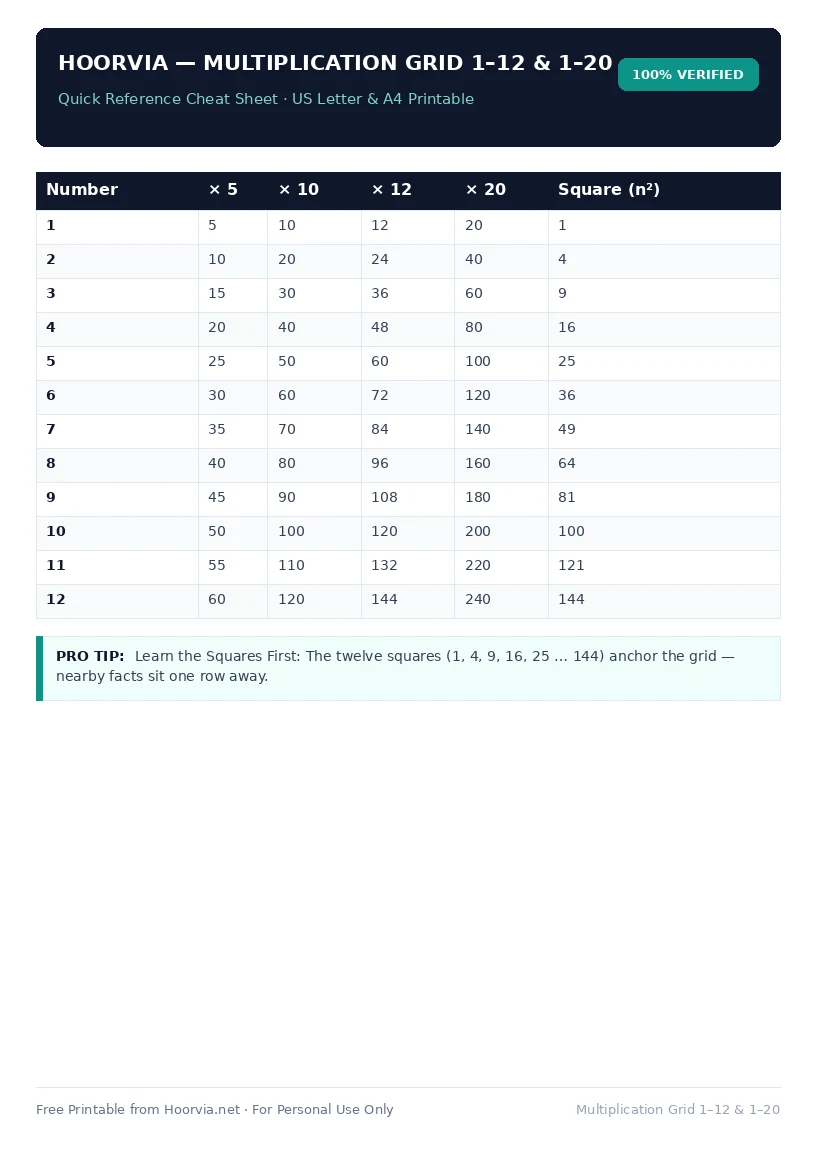
Download Your Free Printable Sheet
Download the printable PDF below. It is the same sheet shown in the preview above, ready to print on US Letter or A4 — open it and choose Print, with Scale set to Fit to Page.
💡 Pro Printing Tip: In your printer settings, set Scale to “Fit to Printable Area” and enable “Background Graphics” for color headers.