Sewing Machine Needle Sizes Chart: Printable Fabric & Needle Guide
Skipped stitches, snapped thread, and puckered seams usually trace back to one small culprit: the wrong needle in the machine. A heavy 100/16 jeans needle punches visible holes in chiffon, while a fine 70/10 flexes and snaps in thick denim. Needle choice matters twice — the size and the type. Both the European number (60–110) and the US number (8–18) printed on the package describe the same thickness, and needle types like Universal, Ball Point, Denim, and Leather each carry a different point for a different fabric. Decoding all of that mid-project is frustrating. This printable chart pairs every common fabric with the exact EU and US needle size and the right needle type, from Microtex needles for sheers to leather needles for vinyl. Consult the live reference table below before you thread up, or print the sheet below and tape it inside your sewing cabinet — the right needle turns fights with the machine into smooth seams.
Quick-Reference Table
The full data from this cheat sheet, right on the page.
| Fabric | EU Size | US Size | Needle Type | Why This Needle |
|---|---|---|---|---|
| Chiffon / Organza / Voile | 60–70 | 8–10 | Microtex / Sharp | Ultra-fine sharp point pierces delicate sheers without snagging |
| Batiste / Silk / Taffeta | 70 | 10 | Microtex / Sharp | Thin sharp point for tightly woven fine fabrics |
| Quilting Cotton / Muslin | 75–80 | 11–12 | Universal | Slightly rounded point suits medium-weight cottons |
| Linen / Poplin / Shirting | 80–90 | 12–14 | Universal | Reliable all-rounder for medium wovens |
| Jersey / T-Shirt Knit | 75–80 | 11–12 | Ball Point | Rounded tip slides between knit loops instead of cutting them |
| Interlock / Sweatshirt Fleece | 80–90 | 12–14 | Ball Point | Rounded point protects thicker knit fibers from runs |
| Spandex / Swimwear / Activewear | 75–90 | 11–14 | Stretch | Special scarf and coating prevent skipped stitches in high-stretch fabric |
| Denim / Jeans (Light–Medium) | 90 | 14 | Jeans / Denim | Reinforced shaft handles twill without deflecting |
| Heavy Denim / Canvas / Duck | 100–110 | 16–18 | Jeans / Denim | Thick strong shaft punches through dense layers |
| Leather / Suede / Vinyl | 90–100 | 14–16 | Leather | Wedge-shaped cutting point slices cleanly through non-wovens |
| Quilting (Layers + Batting) | 75–90 | 11–14 | Quilting | Tapered point pierces sandwich layers without damage |
| Machine Embroidery | 75–90 | 11–14 | Embroidery | Larger eye and groove suit dense embroidery threads |
How to Use This Chart
Pin this chart where you work: it packs 12 entries and 5 columns (Fabric, EU Size, US Size, Needle Type, Why This Needle) into one printable page, built for quick lookups.
Scan down the Fabric column to your item, then read across for EU Size, US Size, Needle Type, Why This Needle.
Example: for Chiffon / Organza / Voile, the chart gives EU Size of 60–70.
- Compare values down a single column to spot the pattern before you commit to a choice.
- When two rows look close, the last column usually breaks the tie.
- Print it once and keep it where you work — that's the whole point of a cheat sheet.
💡 Quick Tips
Match Size to Weight: Sheers take 60–70 (8–10), denim takes 90–110 (14–18) — wrong size skips stitches or tears fabric.
Pick the Right Type: Microtex for wovens, Ballpoint for knits, Denim for heavy seams — the point decides success.
Change Every Project: A needle dulls after roughly 8 sewing hours — swap in a fresh one each project.
Frequently Asked Questions
What do the two numbers on a needle packet mean, like 80/12?
The first number is the European (metric) size, the second is the American size — both describe the same needle thickness. A higher number means a thicker needle: 60/8 suits sheers, while 110/18 handles heavy denim and leather. Schmetz, Singer, and most brands print both.
Can I just use a Universal needle for everything?
Universal needles handle most wovens and stable fabrics, but specialty fabrics sew better with the matching point. Ball point needles prevent runs in jersey, stretch needles stop skipped stitches in spandex, and leather needles cut rather than pierce — using the right type visibly improves stitch quality.
How do I know when my needle needs replacing?
Listen and look: a dull needle makes a thudding sound, skips stitches, or pulls threads and puckers the seam. Replace the needle roughly every eight hours of sewing or at the start of each new project — needles are cheap, ruined fabric is not.
Printable Sheet Preview
High-Contrast Layout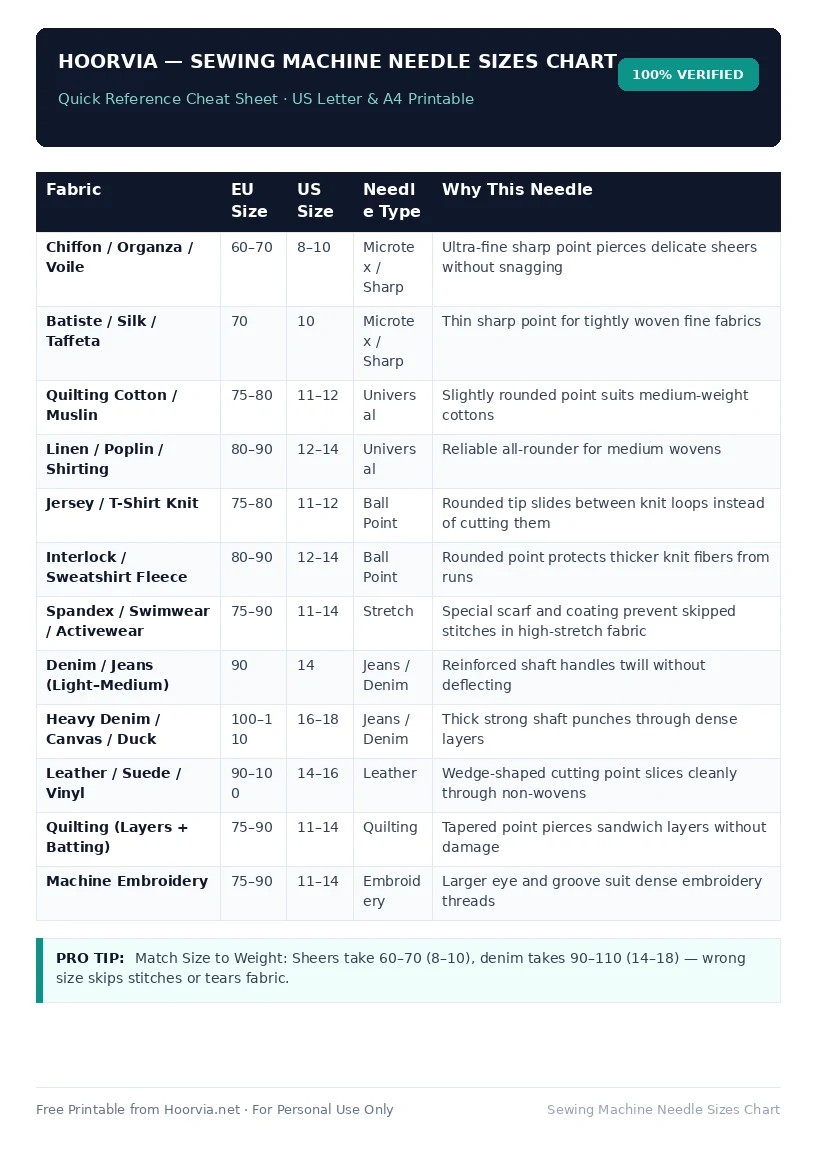
Download Your Free Printable Sheet
Download the printable PDF below. It is the same sheet shown in the preview above, ready to print on US Letter or A4 — open it and choose Print, with Scale set to Fit to Page.
💡 Pro Printing Tip: In your printer settings, set Scale to “Fit to Printable Area” and enable “Background Graphics” for color headers.