Natural Release vs. Quick Release Chart: Printable Instant Pot Steam Release Guide
Choosing the wrong steam release method at the end of a pressure cooking cycle can ruin a dish in seconds. Flipping the valve to Quick Release (QPR) on a pot of beef roast or dry beans causes rapid decompression that boils liquid violently inside the meat fibers—turning beef tough and splitting bean skins—or shoots starchy foam straight through your steam valve. Conversely, leaving delicate broccoli or fish on Natural Pressure Release (NPR) steams them into mush while the float valve slowly drops. This printable Natural Release vs. Quick Release chart takes the guesswork out of electric pressure cooking by mapping 12 major food categories to their exact release method: Instant Quick Release, Timed 10-Minute NPR, or Full Natural Release. Check the reference table below while cooking, or print the sheet below to magnetize right onto your fridge or pantry door near your Instant Pot.
Quick-Reference Table
The full data from this cheat sheet, right on the page.
| Food Category & Examples | Best Release Method | Wait Time Before Venting | Why This Method Is Required |
|---|---|---|---|
| Delicate Vegetables (Broccoli, Asparagus, Corn) | Quick Release (QPR) | 0 mins (Vent immediately) | Stops carryover steaming instantly so greens stay crisp and bright |
| Seafood & Fish (Shrimp, Salmon Filets) | Quick Release (QPR) | 0 mins (Vent immediately) | Prevents delicate seafood proteins from overcooking and turning rubbery |
| Eggs (Hard-Boiled & Soft-Boiled) | Quick Release (QPR) | 0 mins (+ immediate ice bath) | Halts yolk cooking right on time and prevents green sulfur rings |
| Boneless Chicken Breasts (Whole or Diced) | Timed 5–10 Min NPR | 5 to 10 mins, then vent | Prevents sudden moisture loss that makes white meat stringy and dry |
| White, Jasmine & Basmati Rice | Timed 10 Min NPR | 10 mins, then vent | Allows surface starch to settle and moisture to equalize without gummy grains |
| Brown Rice, Wild Rice & Steel-Cut Oats | Timed 10–15 Min NPR | 10 to 15 mins, then vent | Prevents thick foaming starch from sputtering out of the steam valve |
| Pasta & Macaroni Dishes | Controlled / Pulse QPR | Short bursts over 2 mins | Stops pasta from getting mushy while keeping starchy sauce inside the pot |
| Large Roasts (Chuck Roast, Pork Shoulder, Ribs) | Full or 15–20 Min NPR | 15 to 25 mins (Until pin drops) | Lets muscle fibers relax gradually so juices stay locked inside the meat |
| Bone-In Poultry & Whole Chicken | Timed 10–15 Min NPR | 10 to 15 mins, then vent | Protects skin and dark meat texture while finishing carryover cooking |
| Dry Beans, Lentils & Chickpeas | Full Natural Release | 15 to 25 mins (Until pin drops) | Stops rapid boiling turbulence that blows bean skins off and foams the valve |
| Broth, Bone Stock & Full-Pot Soups | Full Natural Release | 20 to 30 mins (Until pin drops) | Keeps high liquid volume from erupting through the venting knob |
| Cheesecake, Custards & Cheesecake Bites | Full Natural Release | 15 to 20 mins (Until pin drops) | Prevents sudden pressure drop that causes custard surfaces to bubble and crack |
How to Use This Chart
Pin this chart where you work: it packs 12 entries and 4 columns (Food Category & Examples, Best Release Method, Wait Time Before Venting, Why This Method Is Required) into one printable page, built for quick lookups.
Scan down the Food Category & Examples column to your item, then read across for Best Release Method, Wait Time Before Venting.
Example: for Delicate Vegetables (Broccoli, Asparagus, Corn), the chart gives Best Release Method of Quick Release (QPR).
- Compare values down a single column to spot the pattern before you commit to a choice.
- When two rows look close, the Why This Method Is Required column usually breaks the tie.
- Print it once and keep it where you work — that's the whole point of a cheat sheet.
💡 Quick Tips
Controlled Pulse Release: If starchy liquid starts sputtering during a Quick Release, immediately close the valve, wait 3 minutes, and open it in short 2-second bursts.
NPR Time Vary by Volume: A nearly empty pot depressurizes naturally in 8 minutes; a pot filled to the Max line can take 30 minutes.
Frequently Asked Questions
What does "10-Minute Natural Release" (10 Min NPR) actually mean?▼
It means that once the pressure cooking timer beeps at zero, you do nothing for 10 minutes while the pot sits on Warm. Once the display reads L0:10, turn the steam valve to Venting to release any remaining pressure and open the lid.
Why does Quick Release make beef roast and pork shoulder tough?▼
Releasing pressure instantly drops the boiling point inside the pot all at once. The superheated water trapped inside the meat flashes into steam and forces its way out of the muscle fibers, leaving the roast dry and tightly contracted.
Does turning off the "Keep Warm" button speed up a Natural Pressure Release?▼
It makes only a minimal difference (usually saving 1 to 2 minutes). The "Keep Warm" heater only kicks on after internal pot temperatures drop well below the point where the float valve has already fallen.
Printable Sheet Preview
High-Contrast Layout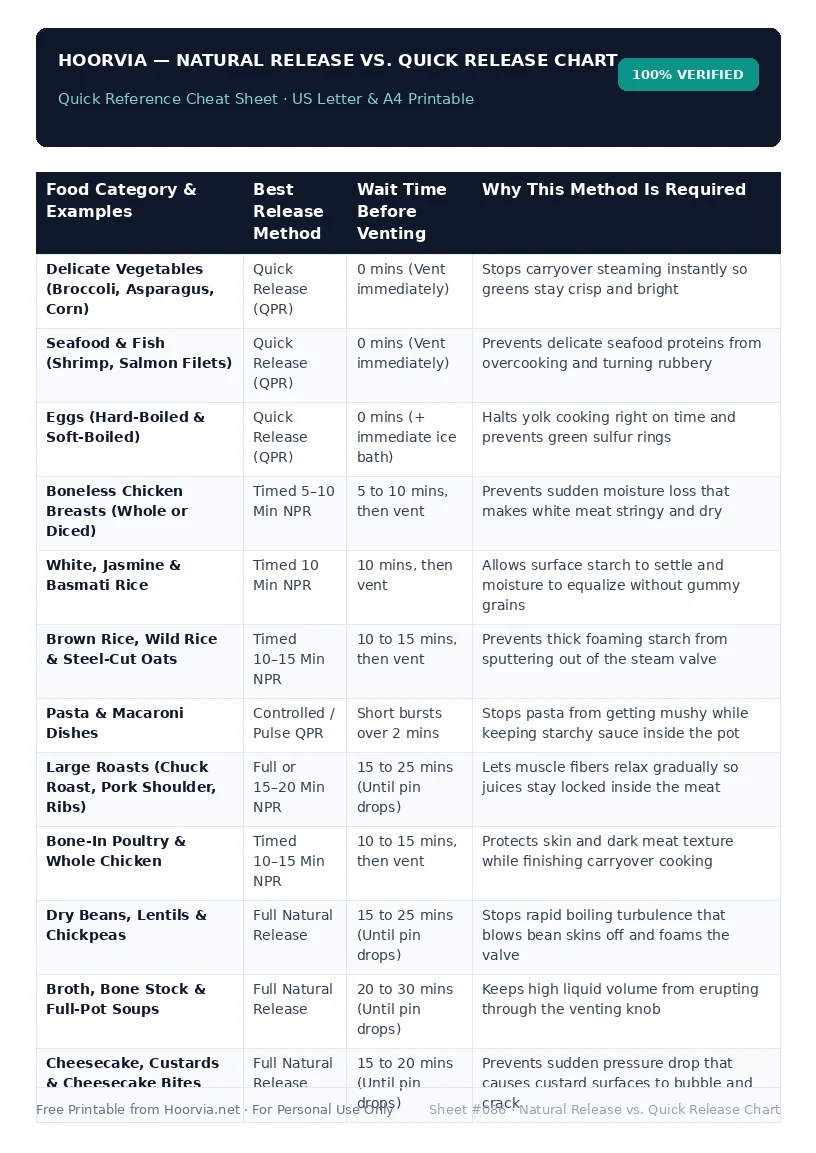
Download Your Free Printable Sheet
Download the printable PDF below. It is the same sheet shown in the preview above, ready to print on US Letter or A4 — open it and choose Print, with Scale set to Fit to Page.
💡 Pro Printing Tip: In your printer settings, set Scale to “Fit to Printable Area” and enable “Background Graphics” for color headers.