Ohm's Law & Power Formulas Chart: Printable Electrical Equations Guide
Electrical math fails the moment you guess at it, and a wrong guess on volts and amps costs more than a failed question: blown fuses, tripped breakers, overheated wire, or a motor that never reaches full power. The problem is not that the formulas are hard — Ohm's law is just V = I × R — but that every real job needs a different version: solving for current from power, resistance from voltage and power, or real watts on an AC circuit with power factor. Flipping the formula wrong in a job means wire sized too small or a breaker sized too big. This printable chart collects the 12 equations you reach for: the three Ohm's law arrangements, the three power formulas, four solve-for variants, and single-phase plus three-phase AC power, each with SI units and a worked example. Consult the live reference table below, or print the sheet and keep it in the toolbox.
Quick-Reference Table
The full data from this cheat sheet, right on the page.
| Formula / What It Finds | Standard Equation | Solve-For Variants | SI Units | Worked Example |
|---|---|---|---|---|
| Ohm's Law (Voltage Drop) | V = I × R | I = V / R ; R = V / I | Volts (V) | A 10.0 Ω heating element drawing 12.0 A needs V = 12.0 × 10.0 = 120.0 V |
| Ohm's Law (Current Draw) | I = V / R | V = I × R ; R = V / I | Amperes (A) | 120 V across 15.0 Ω draws I = 120 / 15.0 = 8.0 A |
| Ohm's Law (Resistance) | R = V / I | V = I × R ; I = V / R | Ohms (Ω) | A lamp drawing 0.50 A on 120 V has R = 120 / 0.50 = 240.0 Ω |
| Watt's Law (Power) | P = V × I | I = P / V ; V = P / I | Watts (W) | 120 V × 12.0 A = 1,440.0 W (80% of a 15 A circuit) |
| Joule's Law (I²R Heating) | P = I² × R | I = √(P / R) ; R = P / I² | Watts (W) | 15.0 A through 0.40 Ω wastes 15² × 0.40 = 90.0 W as heat |
| Voltage-Resistance Power | P = V² / R | V = √(P × R) ; R = V² / P | Watts (W) | 120 V across 8.0 Ω gives (120)² / 8.0 = 1,800.0 W |
| Solve for Voltage (Power & Current) | V = P / I | P = V × I ; I = P / V | Volts (V) | A 1,500 W heater drawing 12.5 A runs at V = 1,500 / 12.5 = 120.0 V |
| Solve for Current (Power & Resistance) | I = √(P / R) | P = I² × R ; R = P / I² | Amperes (A) | A 900 W element of 10.0 Ω draws I = √(900 / 10) = 9.49 A |
| Solve for Resistance (Power & Current) | R = P / I² | I = √(P / R) ; P = I² × R | Ohms (Ω) | A 1,200 W load at 10.0 A has R = 1,200 / 100 = 12.0 Ω |
| Solve for Resistance (Voltage & Power) | R = V² / P | V = √(P × R) ; P = V² / R | Ohms (Ω) | A 60 W bulb on 120 V has R = 14,400 / 60 = 240.0 Ω |
| Single-Phase AC Real Power | P = V × I × PF | PF = cos(θ) = P / (V × I) ; S = V × I (VA) | Watts (W) vs Volt-Amps (VA) | A 120 V motor at 10.0 A, 0.85 PF delivers 120 × 10.0 × 0.85 = 1,020.0 W |
| Three-Phase AC Real Power | P = √3 × V_LL × I_L × PF | √3 ≈ 1.732 ; I_L = P / (√3 × V_LL × PF) | Watts (W) / Kilowatts (kW) | A 480 V feeder at 30.0 A, 0.90 PF delivers 1.732 × 480 × 30.0 × 0.90 = 22,447 W (22.45 kW) |
How to Use This Chart
Pin this chart where you work: it packs 12 entries and 5 columns (Formula / What It Finds, Standard Equation, Solve-For Variants, SI Units, Worked Example) into one printable page, built for quick lookups.
Scan down the Formula / What It Finds column to your item, then read across for Standard Equation, Solve-For Variants, SI Units, Worked Example.
Example: for Ohm's Law (Voltage Drop), the chart gives Standard Equation of V = I × R.
- Compare values down a single column to spot the pattern before you commit to a choice.
- When two rows look close, the last column usually breaks the tie.
- Print it once and keep it where you work — that's the whole point of a cheat sheet.
💡 Quick Tips
Memorize the triangle: Cover the letter you want in the V-I-R triangle; the remaining two reveal the formula — the fastest recall.
Convert units first: Milliamps and kilowatts shift answers by a thousand — convert to volts, amps, and ohms before calculating.
Size for 125% loads: Loads running 3+ hours need 125%-rated wiring and breakers — a 1,440 W heater is the ceiling on 15 A.
Frequently Asked Questions
How do I solve for amps if I only know watts and volts?
Divide watts by volts: I = P / V. A 1,500 W appliance on a 120 V circuit draws 12.5 A. That is the same formula electricians use to check whether a circuit has room for one more device.
Why does voltage drop matter on long wire runs?
Every foot of wire adds resistance, and resistance × current becomes voltage lost as heat. On a long run of thin wire, the voltage at the far outlet can sag enough to dim lights or underfeed motors.
What is the difference between watts and volt-amps?
Watts measure real power that does work; volt-amps measure apparent power including stored energy. On AC circuits with motors or power supplies, the two differ by the power factor, so size conductors for VA, not just watts.
Printable Sheet Preview
High-Contrast Layout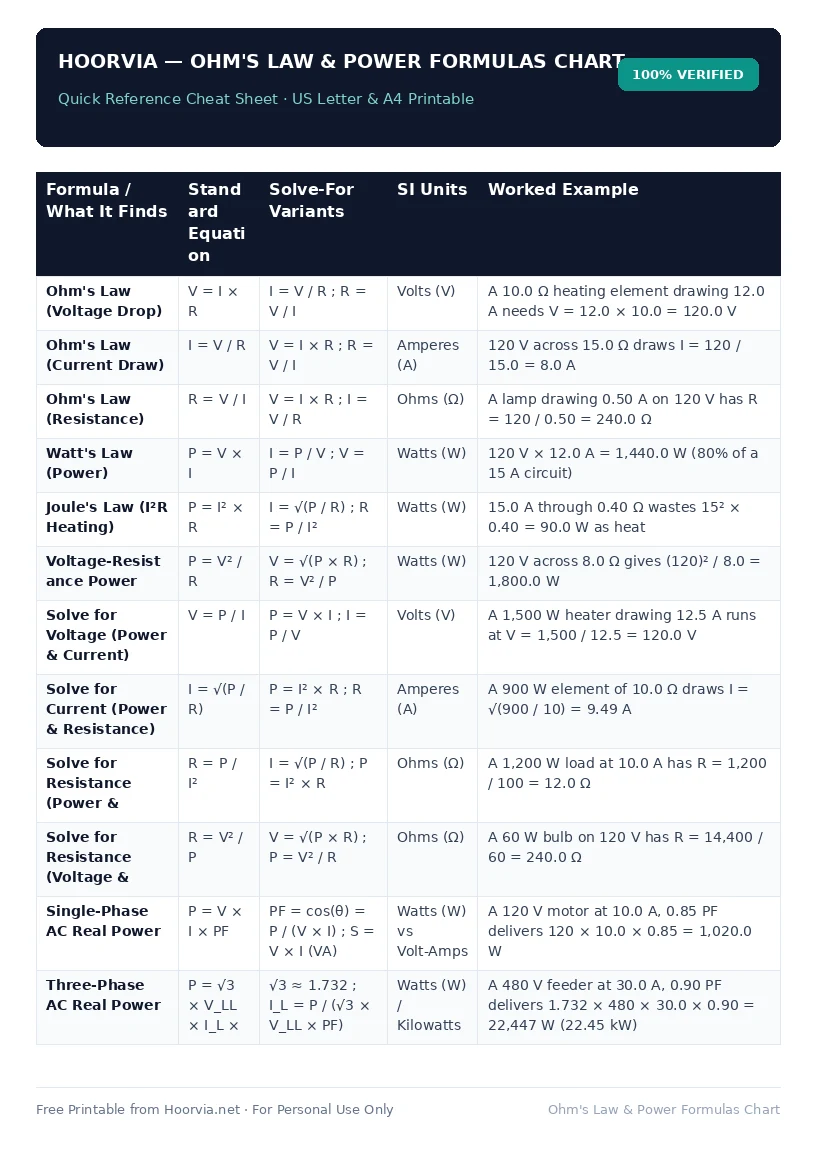
Download Your Free Printable Sheet
Download the printable PDF below. It is the same sheet shown in the preview above, ready to print on US Letter or A4 — open it and choose Print, with Scale set to Fit to Page.
💡 Pro Printing Tip: In your printer settings, set Scale to “Fit to Printable Area” and enable “Background Graphics” for color headers.