Oil Change Records Chart: Printable Intervals & Maintenance Log
Most cars do not need an oil change every 3,000 miles anymore, yet many drivers still follow the old rule and throw away money — or follow no rule at all and quietly wear out their engines. Modern full-synthetic oil can run 7,500 to 10,000 miles, but towing, short trips, and dusty roads cut that in half, and nobody remembers the exact date or mileage of the last change without writing it down. That is why this printable sheet pairs the right interval for every oil type and driving condition with a simple record-keeping format: date, mileage, oil grade, and what went in the crankcase. Consult the live reference table below to set your interval, then print the sheet and log every change in the glove box.
Quick-Reference Table
The full data from this cheat sheet, right on the page.
| Oil / Task | Change Interval | Key Spec | What to Log |
|---|---|---|---|
| Full Synthetic Oil & Filter | 7,500–10,000 mi or 12 months | API SP / ILSAC GF-6 (0W-20 or 5W-30) | Date, mileage, brand and grade |
| Synthetic Blend Oil & Filter | 5,000–7,500 mi or 6 months | API SP | Date, mileage, shop or DIY |
| Conventional Oil & Filter | 3,000–5,000 mi or 6 months | API SP | Date, mileage, next-due sticker |
| High-Mileage Oil (75k+ miles) | 5,000–7,500 mi | Seal conditioners | Note any leaks or consumption |
| Severe-Duty Schedule | 3,000–5,000 mi | Short trips, towing, dust, heat | Driving condition that trip |
| Diesel Engine Oil & Filter | 5,000–7,500 mi | API CK-4 | Ash content and regen notes |
| European-Spec Oil | Per owner's manual | ACEA A3/B4 or VW 502 00 | Approval code on the bottle |
| First Oil Change (Break-In) | 500–1,000 mi | Manufacturer guidance | Mileage and metal-shaving check |
| Oil Filter Replacement | Every oil change | OEM cartridge or spin-on spec | Part number used |
| Dipstick Level Check | Monthly | Amber-brown = healthy | Top-off amount added |
| Oil Life Monitor Reset | After each change | Follow dash procedure | Confirm 100% on the cluster |
| Used Oil Recycling | Each change | Sealed container, local program | Gallons dropped off, receipt |
How to Use This Chart
Pin this chart where you work: it packs 12 entries and 4 columns (Oil / Task, Change Interval, Key Spec, What to Log) into one printable page, built for quick lookups.
Scan down the Oil / Task column to your item, then read across for Change Interval, Key Spec, What to Log.
Example: for Full Synthetic Oil & Filter, the chart gives Change Interval of 7,500–10,000 mi or 12 months.
- Compare values down a single column to spot the pattern before you commit to a choice.
- When two rows look close, the last column usually breaks the tie.
- Print it once and keep it where you work — that's the whole point of a cheat sheet.
💡 Quick Tips
Follow the manual first: Your owner's manual beats any generic interval — some engines spec 10,000-mile synthetic runs, others demand 5,000 regardless.
Log the odometer, not just the date: Mileage is the only number that tells you when oil is actually spent, so record the odometer reading at every change.
Check the dipstick monthly: Catching low oil early costs nothing and prevents the kind of wear no interval debate can undo.
Frequently Asked Questions
How often should I really change my oil?
Follow your owner's manual: most modern cars run 7,500–10,000 miles on full synthetic, but severe duty — towing, short trips, dust — cuts that to 3,000–5,000. Your driving pattern decides, not the old 3,000-mile myth.
Can I switch from conventional to synthetic oil?
Yes, engines switch safely in either direction at any mileage, as long as the grade matches the manual. Synthetic resists breakdown longer and flows better in cold starts, which is why most new cars spec it.
What should I write down at each oil change?
Date, odometer mileage, oil grade and brand, filter part number, and who did the work. Five lines per change creates a service history that protects your warranty and boosts resale value.
Printable Sheet Preview
High-Contrast Layout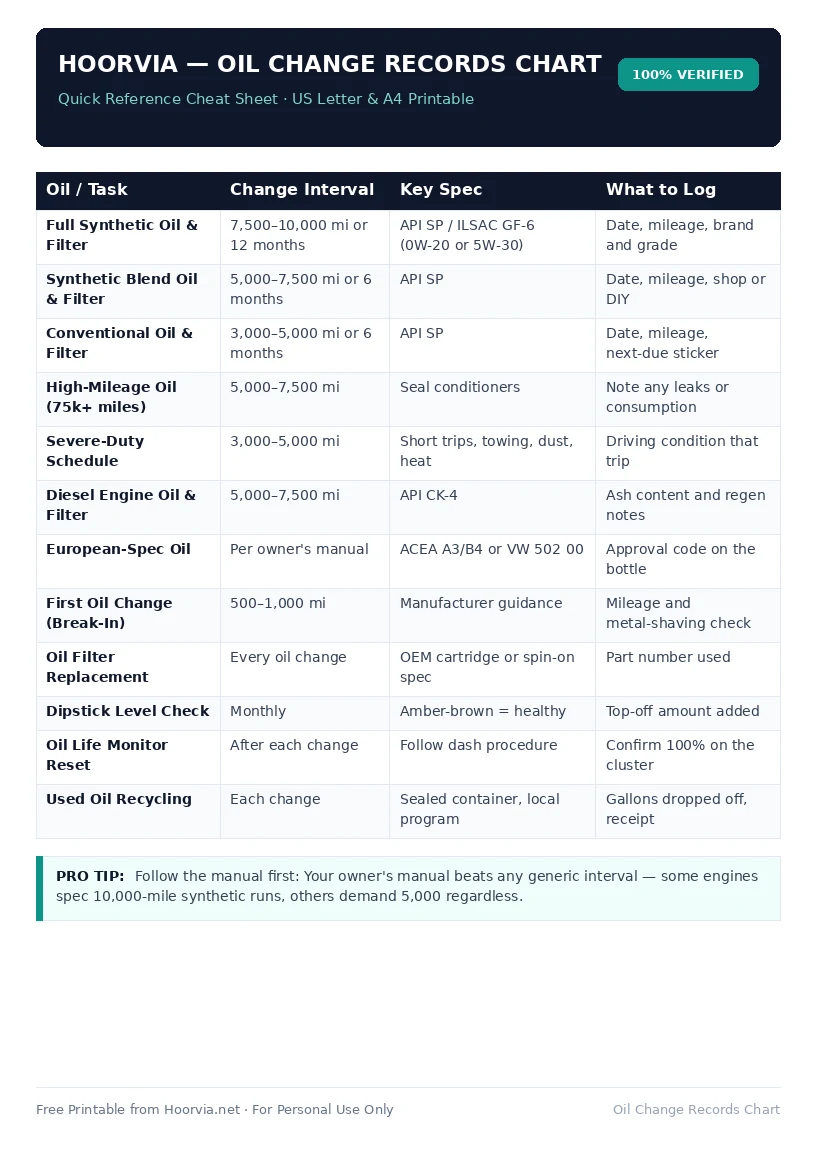
Download Your Free Printable Sheet
Download the printable PDF below. It is the same sheet shown in the preview above, ready to print on US Letter or A4 — open it and choose Print, with Scale set to Fit to Page.
💡 Pro Printing Tip: In your printer settings, set Scale to “Fit to Printable Area” and enable “Background Graphics” for color headers.