Motor Oil Viscosity Chart: Printable SAE Grade Guide
Choosing the wrong motor oil viscosity is one of the easiest ways to quietly shorten an engine's life. The numbers on the bottle — 0W-20, 5W-30, 10W-40 — are not brand codes but the SAE J300 grading system: the number before the W rates cold-start flow in winter, and the number after rates thickness at full operating temperature. Pour an oil that stays too thick at startup and the bearings run dry for the first critical seconds; pick one too thin at 100°C and the oil film collapses under load, inviting wear and faster oil consumption. No additive package fixes the wrong grade. This printable chart maps the 12 grades drivers actually buy — from 0W-16 hybrids to 20W-50 classics — with winter cold-crank limits, 100°C viscosity ranges, and typical uses. Consult the live reference table below, or print the sheet and keep it with your service records so the right grade is always at hand.
Quick-Reference Table
The full data from this cheat sheet, right on the page.
| SAE Grade | Winter (W) Rating | Viscosity @ 100°C (cSt) | Cold-Crank Limit | Typical Use |
|---|---|---|---|---|
| 0W-16 | 0W | 6.1–8.2 | -35°C | Latest-model hybrids chasing maximum fuel economy |
| 0W-20 | 0W | 5.6–9.3 | -35°C | Most new gasoline cars and hybrids (check manual) |
| 5W-20 | 5W | 5.6–9.3 | -30°C | Many American and Asian sedans and SUVs |
| 5W-30 | 5W | 9.3–12.5 | -30°C | The common all-rounder for moderate climates |
| 10W-30 | 10W | 9.3–12.5 | -25°C | Older engines and warmer regions |
| 0W-40 | 0W | 12.5–16.3 | -35°C | European performance cars, wide-temp range |
| 5W-40 | 5W | 12.5–16.3 | -30°C | European and turbocharged engines |
| 10W-40 | 10W | 12.5–16.3 | -25°C | High-mileage or older gasoline engines |
| 15W-40 | 15W | 12.5–16.3 | -20°C | Diesel trucks, tractors, heavy equipment |
| 15W-50 | 15W | 16.3–21.9 | -20°C | Sport bikes, air-cooled engines, hot climates |
| 20W-50 | 20W | 16.3–21.9 | -15°C | Classic cars, racing, very hot weather |
| 10W-60 | 10W | 21.9–26.1 | -25°C | Track cars and extreme heat duty |
How to Use This Chart
Pin this chart where you work: it packs 12 entries and 5 columns (SAE Grade, Winter (W) Rating, Viscosity @ 100°C (cSt), Cold-Crank Limit, Typical Use) into one printable page, built for quick lookups.
Scan down the SAE Grade column to your item, then read across for Winter (W) Rating, Viscosity @ 100°C (cSt), Cold-Crank Limit, Typical Use.
Example: for 0W-16, the chart gives Winter (W) Rating of 0W.
- Compare values down a single column to spot the pattern before you commit to a choice.
- When two rows look close, the last column usually breaks the tie.
- Print it once and keep it where you work — that's the whole point of a cheat sheet.
💡 Quick Tips
Cold starts rule: A 0W oil cranks at -35°C while 15W quits near -20°C. Buy for your winter, not your summer.
Manual grade wins: Your manual's grade fits the engine's tolerances and pump. Deviate only for mileage, track use, or heat.
Feel test lies: Finger feel means nothing — grades are measured at 100°C, where every 30-weight behaves the same.
Frequently Asked Questions
What does 5W-30 actually mean?
5W rates winter flow: the oil passes cold-cranking tests at -30°C. 30 means its viscosity at 100°C sits between 9.3 and 12.5 cSt. Multigrades earn both ratings — the W grade from winter tests, the second number from hot-temperature tests.
Can I use 10W-40 instead of 5W-30?
Only if your manual allows it. 10W-40 is thicker at startup and at operating temperature, which protects older, looser engines but raises cold-start wear and fuel use in modern tight-tolerance engines. Check the manual's approved range first.
Is 0W-20 just thinner 5W-20?
Mostly yes at operating temperature — both are SAE 20 grades. The difference is cold flow: 0W oils crank down to -35°C versus -30°C for 5W. 0W-20 is specified for many modern engines for faster winter lubrication and slightly better fuel economy.
Printable Sheet Preview
High-Contrast Layout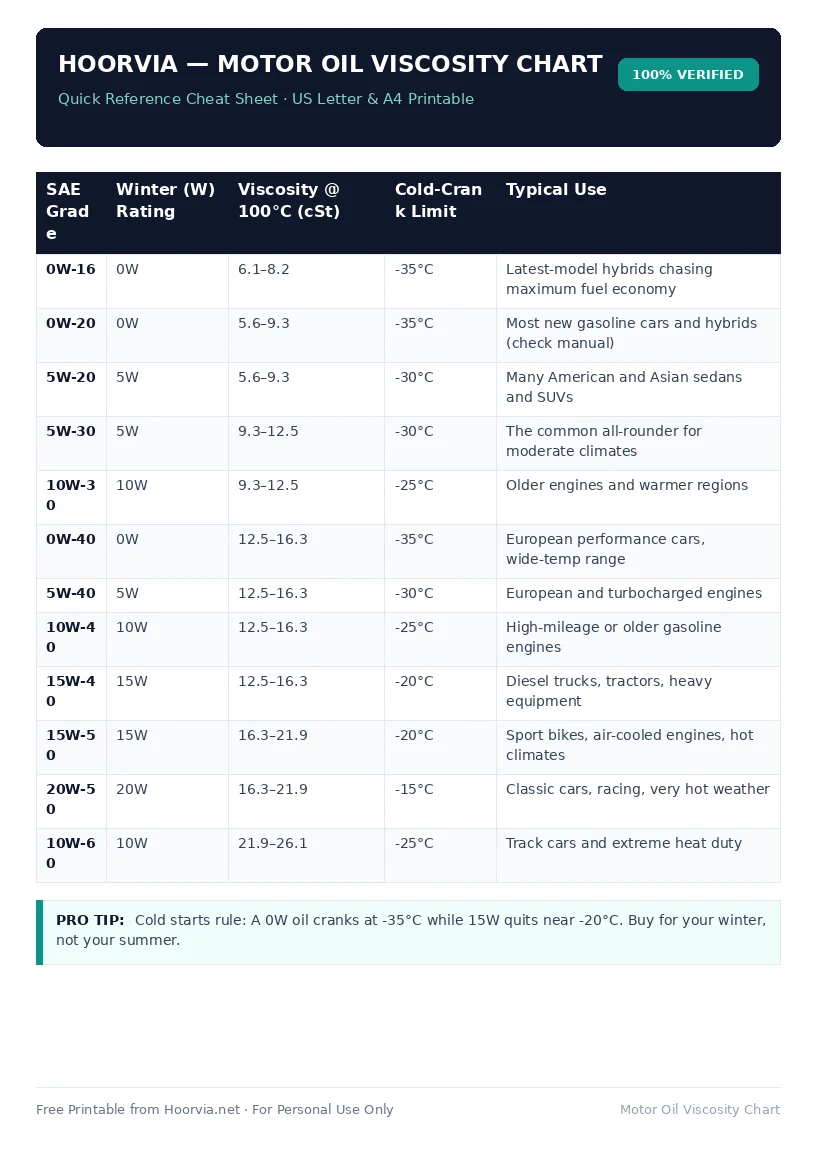
Download Your Free Printable Sheet
Download the printable PDF below. It is the same sheet shown in the preview above, ready to print on US Letter or A4 — open it and choose Print, with Scale set to Fit to Page.
💡 Pro Printing Tip: In your printer settings, set Scale to “Fit to Printable Area” and enable “Background Graphics” for color headers.