OOP Concepts Chart: Printable Object-Oriented Programming Reference
Every beginner hears the four pillars of OOP — encapsulation, inheritance, polymorphism, abstraction — then opens a real codebase and sees none of them labeled. The concepts are easy to recite and hard to recognize, because professional code hides them inside small decisions: a private field that prevents a bug, a subclass that reuses a parent instead of copying it, one method call that behaves differently on each object. The classic interview question — “what is polymorphism?” — punishes anyone who memorized a sentence instead of the pattern. This printable chart distills object-oriented programming into 12 concepts — classes, objects, constructors, the four pillars, interfaces, overriding, access control, and composition — each with a plain-English meaning, a code example, and why it actually matters. Consult the live reference table below, or print the sheet and pin it where you study or interview.
Quick-Reference Table
The full data from this cheat sheet, right on the page.
| Concept | What It Means | Example in Code | Why It Matters |
|---|---|---|---|
| Class | Blueprint defining attributes and behavior | class Car: ... | One definition builds many consistent objects |
| Object / Instance | A concrete thing built from a class | my_car = Car() | Classes only matter when instantiated |
| Constructor | Special method that builds an object | __init__(self, brand) | Guarantees every object starts in a valid state |
| Method | A function that belongs to an object | car.start() | Behavior lives with the data it acts on |
| Encapsulation | Bundling data together and hiding internals | self._mileage (private) | Stops other code from breaking your internals |
| Inheritance | Child class reuses the parent's features | class Truck(Car): ... | Reuse working code instead of rewriting it |
| Polymorphism | Same call, different behavior per object | car.start() vs truck.start() | One interface handles many object shapes |
| Abstraction | Show what it does, hide how it works | brake() without knowing hydraulics | Teams work on parts without knowing every detail |
| Interface / Abstract Class | A contract of methods a class must have | @abstractmethod | Forces consistent shapes across classes |
| Overriding vs Overloading | Replace or reuse a method signature | child.start() vs start(x) / start() | Specialize inherited behavior without touching the parent |
| Access Modifiers | Who can see what: public, protected, private | self._protected, self.__private | Controls the surface area others can misuse |
| Composition | Building objects from parts, not parents | self.engine = Engine() | 'Has-a' beats deep 'is-a' inheritance chains |
How to Use This Chart
Pin this chart where you work: it packs 12 entries and 4 columns (Concept, What It Means, Example in Code, Why It Matters) into one printable page, built for quick lookups.
Scan down the Concept column to your item, then read across for What It Means, Example in Code, Why It Matters.
Example: for Class, the chart gives What It Means of Blueprint defining attributes and behavior.
- Compare values down a single column to spot the pattern before you commit to a choice.
- When two rows look close, the last column usually breaks the tie.
- Print it once and keep it where you work — that's the whole point of a cheat sheet.
💡 Quick Tips
Read real code: Open a popular library and label what you find — private fields are encapsulation, overridden methods are polymorphism.
Compose, don't inherit deeply: Deep ‘is-a’ chains turn brittle. ‘Has-a’ parts survive requirement changes far better than deep parents.
Name classes like nouns: Car.start() reads like English and needs no comment. doStuffOnCar() needs an apology and a refactor.
Frequently Asked Questions
What is the difference between a class and an object?
A class is the blueprint; an object is the thing built from it. class Car defines doors and a start method, but only my_car = Car() creates a car you can actually drive. One class can spawn thousands of objects, each holding its own data.
Which OOP pillar matters most in interviews?
Polymorphism, because it tests understanding, not memory. Saying ‘same interface, different behavior’ is fine, but the follow-up is always a code example — like a list of Shape objects where draw() renders circles, squares, and triangles differently.
Should I use inheritance or composition?
Use inheritance when the child genuinely is a kind of the parent (a Truck is a Car). Use composition when the object just uses a part (a Car has an Engine). Composition is the safer default because it avoids fragile parent-child coupling.
Printable Sheet Preview
High-Contrast Layout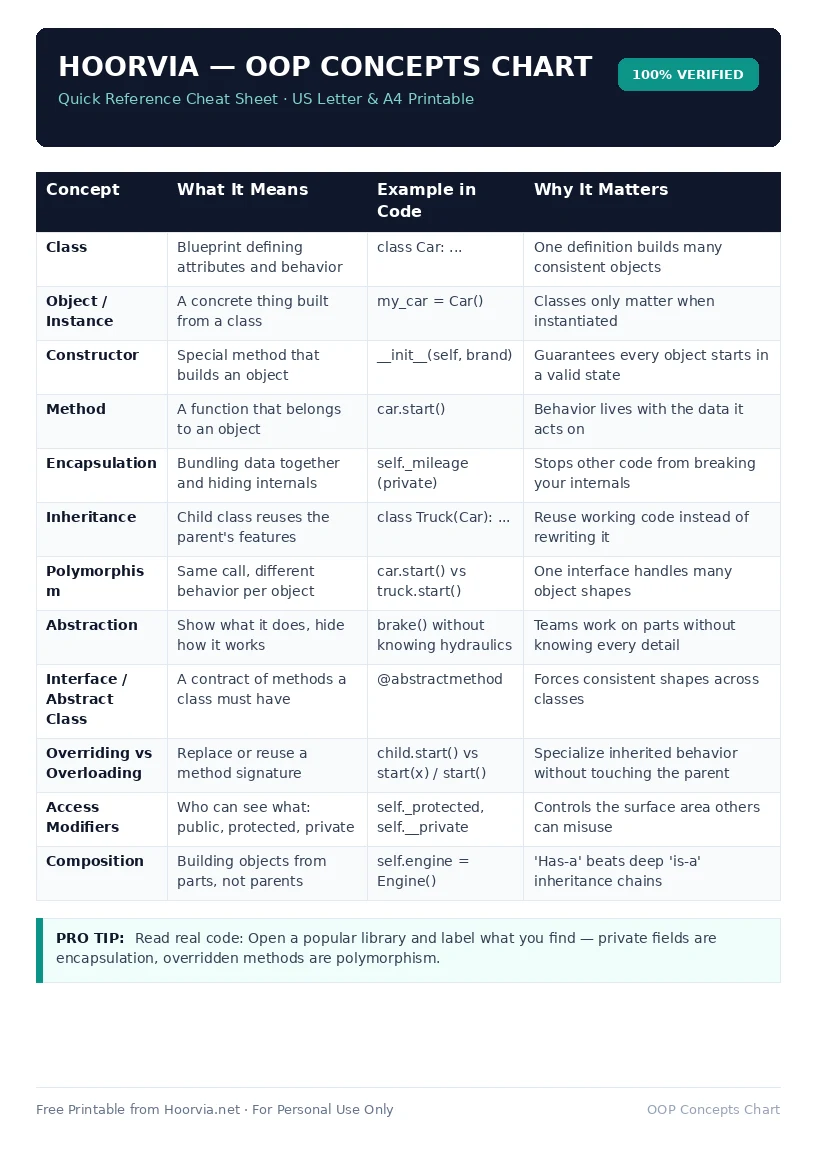
Download Your Free Printable Sheet
Download the printable PDF below. It is the same sheet shown in the preview above, ready to print on US Letter or A4 — open it and choose Print, with Scale set to Fit to Page.
💡 Pro Printing Tip: In your printer settings, set Scale to “Fit to Printable Area” and enable “Background Graphics” for color headers.