Origami Bases Chart: Printable Classic Fold Foundations
Every classic origami model — the crane, the jumping frog, the waterbomb balloon — begins with the same small library of starting shapes called bases. Beginners waste hours following full models without realizing the first six steps are always a base they could have learned once and reused forever. Learn the dozen traditional bases and the instructions of almost any traditional model suddenly read as familiar moves: precrease, collapse, petal fold, done. Each base also teaches a folding technique — squash folds, rabbit ears, blintz folds — that transfers directly to modern designs. This printable chart presents 12 classic bases, from the simple kite base to the blintzed bird base, with how each is folded, the shape it makes, and the famous models it starts. Consult the live reference table below, or print the sheet and keep it with your origami paper.
Quick-Reference Table
The full data from this cheat sheet, right on the page.
| Base | How It's Folded | Shape It Makes | Classic Models It Starts |
|---|---|---|---|
| Preliminary (Square) | Precrease both diagonals + midlines, collapse sides together | Small square with 4 loose flaps | Starting point for the bird and waterbomb bases |
| Waterbomb | Inside-out collapse of the preliminary fold | Square with a hidden inner pocket | Waterbomb balloon, boxes, cups |
| Kite | Fold two adjacent edges to the diagonal center | Kite-shaped diamond with one flap | Swans, simple birds, paper kites |
| Fish | Kite folds on both sides of the diagonal (two rabbit ears) | Slim diamond with two flaps | Angelfish, goldfish, sea creatures |
| Bird | Preliminary fold + petal folds on front and back | Slim diamond with 4 narrow points | Crane, flapping bird, doves |
| Frog | Petal-fold the flaps of a waterbomb base | Square with many small points | Jumping frog, toads |
| Blintz | Fold all four corners to the center | Smaller square with 4 sealed flaps | Fortune tellers (cootie catchers), photo cubes |
| Windmill | Four kite folds, one per corner, to the center | Square with four kite petals | Pinwheels, windmills, flowers |
| Cupboard | Fold left and right edges to meet at the center | Tall rectangle with a center seam | Doors, frames, shirt folds |
| Umbrella | Square base + squash folds + triangle flaps | Layered triangle canopy | Umbrellas, hats, flowers |
| Diamond | Fold pairs of edges toward a diagonal | Long diamond with pointed ends | Gems, crystals, ornaments |
| Blintzed Bird | Blintz the corners in, then fold a bird base | Bird base with many extra flaps | Yoshizawa's crab, complex insects |
How to Use This Chart
Pin this chart where you work: it packs 12 entries and 4 columns (Base, How It's Folded, Shape It Makes, Classic Models It Starts) into one printable page, built for quick lookups.
Scan down the Base column to your item, then read across for How It's Folded, Shape It Makes, Classic Models It Starts.
Example: for Preliminary (Square), the chart gives How It's Folded of Precrease both diagonals + midlines, collapse sides together.
- Compare values down a single column to spot the pattern before you commit to a choice.
- When two rows look close, the last column usually breaks the tie.
- Print it once and keep it where you work — that's the whole point of a cheat sheet.
💡 Quick Tips
Repetition builds hands: Fold each base until you can do it without looking — then every traditional model gets dramatically easier.
Practice on copy paper: Cheap 70–90 gsm copy paper creases crisply and folds well. Save the expensive washi for finished models.
Creases decide everything: Sharp, accurate precreases make a base collapse cleanly. Bone-fold every crease before collapsing.
Frequently Asked Questions
What is the easiest origami base to learn first?
The kite base — fold two adjacent edges to the diagonal center line and you are done. It is the foundation for swans and simple birds, and it teaches the edge-to-center move used in several harder bases.
Why do the bird base and frog base look alike?
Both are built by petal-folding: the bird base petal-folds a preliminary (square) base, while the frog base petal-folds a waterbomb base. The technique is identical; the starting base is what changes the flap count.
What is a blintzed base?
Any base folded after blintz-folding the paper first — folding all four corners to the center. The classic example is the blintzed bird base, which has far more flaps than a plain bird base and was used by Akira Yoshizawa for his famous crab.
Printable Sheet Preview
High-Contrast Layout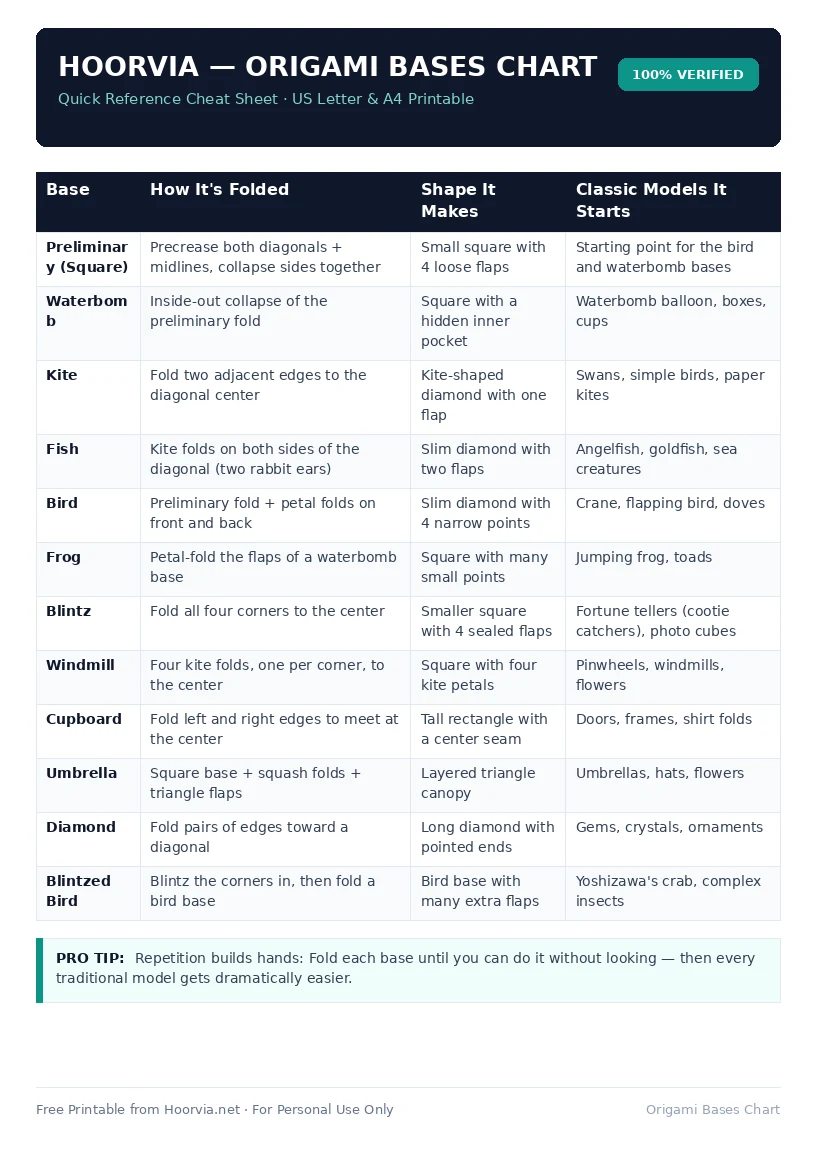
Download Your Free Printable Sheet
Download the printable PDF below. It is the same sheet shown in the preview above, ready to print on US Letter or A4 — open it and choose Print, with Scale set to Fit to Page.
💡 Pro Printing Tip: In your printer settings, set Scale to “Fit to Printable Area” and enable “Background Graphics” for color headers.