Ounces to Grams Conversion Chart: Printable Kitchen Weight Guide
Recipe conversions are where good cooking quietly goes wrong. An American recipe calls for 4 ounces of chocolate, your European scale reads grams, and guessing turns a perfect ganache into a greasy split or a dry, dense cake. Kitchen scales flip between units, but few show both at once, and the math — multiply ounces by 28.3495 — is not something anyone wants to do mid-whisk. Postal and deli scales round differently too, so "about four ounces" can swing by a full tablespoon. This printable chart converts the 15 ounce values home cooks actually reach for, from a quarter ounce of yeast to two pounds of flour, into exact grams with everyday equivalents like half a stick of butter or a block of cream cheese. Consult the live reference table below, or print the sheet and tape it inside a cabinet door where the scale lives.
Quick-Reference Table
The full data from this cheat sheet, right on the page.
| Ounces (oz) | Grams (g) | Also Equals | Quick Kitchen Use |
|---|---|---|---|
| 1/4 oz | 7.1 | 0.25 oz | A packet of yeast or a pinch of salt |
| 1/2 oz | 14.2 | 0.5 oz | Half a serving of deli meat |
| 1 oz | 28.3 | 1 oz | One slice of cheese or deli meat |
| 2 oz | 56.7 | 2 oz | A small chocolate bar or shot of espresso |
| 3 oz | 85.0 | 3 oz | A restaurant serving of cooked meat |
| 4 oz | 113.4 | 1/4 lb | Half a stick of butter |
| 5 oz | 141.7 | 5 oz | A large apple or serving of fish |
| 6 oz | 170.1 | 6 oz | A medium steak fillet |
| 8 oz | 226.8 | 1/2 lb | One block of cream cheese |
| 10 oz | 283.5 | 10 oz | A bag of frozen spinach |
| 12 oz | 340.2 | 3/4 lb | A standard can of soda's weight in meat |
| 16 oz | 453.6 | 1 lb (pound) | A pound of flour or sugar |
| 24 oz | 680.4 | 1-1/2 lb | A small bag of produce |
| 32 oz | 907.2 | 2 lb | A two-pound bag of rice or beans |
How to Use This Chart
Pin this chart where you work: it packs 14 entries and 4 columns (Ounces (oz), Grams (g), Also Equals, Quick Kitchen Use) into one printable page, built for quick lookups.
Scan down the Ounces (oz) column to your item, then read across for Grams (g), Also Equals, Quick Kitchen Use.
Example: for 1/4 oz, the chart gives Grams (g) of 7.1.
- Compare values down a single column to spot the pattern before you commit to a choice.
- When two rows look close, the last column usually breaks the tie.
- Print it once and keep it where you work — that's the whole point of a cheat sheet.
💡 Quick Tips
Weigh, don't scoop: Scooped flour varies up to 30 percent per cup; grams on a scale never lie.
Memorize two anchors: One ounce is 28.3 grams and sixteen ounces is 453.6 grams — everything else follows.
Round smart: Baking forgives tenth-gram differences, so one decimal is plenty for home recipes.
Frequently Asked Questions
How many grams are in one ounce?
Exactly 28.3495 grams. Kitchen charts round this to 28.3, and digital scales usually display 28.35. For cooking, the difference between 28.3 and 28.35 is about a grain of salt — irrelevant in any recipe.
Why do some recipes list ounces and others grams?
US recipes traditionally use volume and ounces while UK, European, and professional recipes weigh ingredients in grams, because weight is faster and more accurate. A scale that flips between oz and g makes any recipe usable.
Is weighing in grams really better than using cups?
Yes for baking. A cup of flour can weigh anywhere from 110 to 150 grams depending on how it is scooped, which ruins delicate ratios. Measuring 120 grams of flour gives the same result every single time.
Printable Sheet Preview
High-Contrast Layout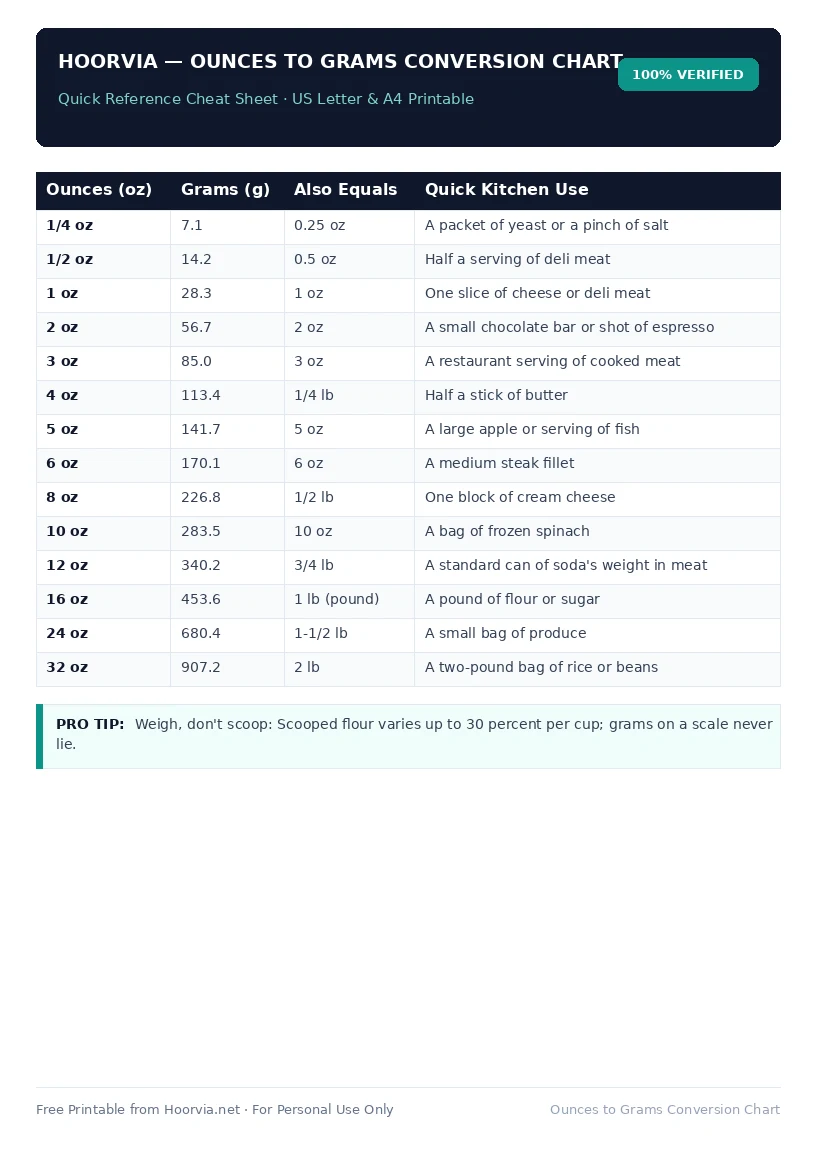
Download Your Free Printable Sheet
Download the printable PDF below. It is the same sheet shown in the preview above, ready to print on US Letter or A4 — open it and choose Print, with Scale set to Fit to Page.
💡 Pro Printing Tip: In your printer settings, set Scale to “Fit to Printable Area” and enable “Background Graphics” for color headers.