Meat Roast Cooking Guide Chart: Printable Oven Roasting Reference
A great roast is decided long before it hits the oven — by matching the right cut to the right temperature and time. Because a lean pork loin and a collagen-loaded chuck roast respond to heat in opposite ways, one generic roasting rule guarantees that something comes out wrong. This printable meat roast cooking guide covers ten essential roasts with the exact oven temperature, minutes per pound, pull temperature, and resting window for each, from holiday prime rib to weeknight roast chicken. Check the table below while your oven preheats, or print the sheet below to keep inside a cabinet door for confident roasting every time.
Quick-Reference Table
The full data from this cheat sheet, right on the page.
| Roast Cut | Typical Weight | Oven Temp | Time | Pull Temp & Rest |
|---|---|---|---|---|
| Prime Rib (bone-in) | 4–6 lbs | 325°F | 20–23 min/lb | 128°F — Rest 20 mins |
| Beef Tenderloin (whole) | 2–3 lbs | 425°F | 12–15 min/lb | 128°F — Rest 15 mins |
| Pork Loin (boneless) | 3–5 lbs | 350°F | 20–25 min/lb | 140°F — Rest 10 mins |
| Pork Shoulder / Butt | 5–8 lbs | 275°F | 45–60 min/lb | 198°F — Rest 30 mins |
| Leg of Lamb (bone-in) | 5–7 lbs | 325°F | 20–24 min/lb | 130°F — Rest 20 mins |
| Whole Chicken | 4–5 lbs | 375°F | 18–20 min/lb | 160°F — Rest 15 mins |
| Turkey Breast (bone-in) | 3–4 lbs | 325°F | 20–25 min/lb | 160°F — Rest 20 mins |
| Ham (fully cooked) | 5–7 lbs | 325°F | 15–18 min/lb | 135°F — Rest 15 mins |
| Whole Duck | 5–6 lbs | 350°F | 18–20 min/lb | 160°F breast — Rest 15 mins |
| Chuck Roast (braised, covered) | 3–4 lbs | 300°F | 45–55 min/lb | 203°F — Rest 15 mins |
How to Use This Chart
Pin this chart where you work: it packs 10 entries and 5 columns (Roast Cut, Typical Weight, Oven Temp, Time, Pull Temp & Rest) into one printable page, built for quick lookups.
Scan down the Roast Cut column to your item, then read across for Typical Weight, Oven Temp.
Example: for Prime Rib (bone-in), the chart gives Typical Weight of 4–6 lbs.
- Compare values down a single column to spot the pattern before you commit to a choice.
- When two rows look close, the Pull Temp & Rest column usually breaks the tie.
- Print it once and keep it where you work — that's the whole point of a cheat sheet.
💡 Quick Tips
Sear Before Roasting: Browning the roast in a hot skillet before it goes into the oven builds a deep, savory crust that oven heat alone cannot create — 3 minutes per side is enough.
Use Two Temperatures: Start lean tender cuts hot (425°F) for a crust, then drop to 325°F to finish gently. For tough cuts, do the reverse: low and slow the whole way.
Frequently Asked Questions
Should I roast with the fat cap up or down?▼
Fat cap up. As the roast cooks, the melting fat bastes the meat below it, keeping the surface moist and adding flavor. Score the cap in a crosshatch so it renders evenly instead of shrinking.
Why does my roast always overcook while resting?▼
Carryover cooking raises the internal temperature 5–10°F after you pull it, more for large roasts. Always pull 5–10°F below your target temperature and let the rest finish the job.
Do I need to baste a roast while it cooks?▼
Rarely. Basting cools the oven each time you open the door and adds little moisture. A well-marbled roast bastes itself; for lean roasts, a foil tent in the final third of cooking works better.
Printable Sheet Preview
High-Contrast Layout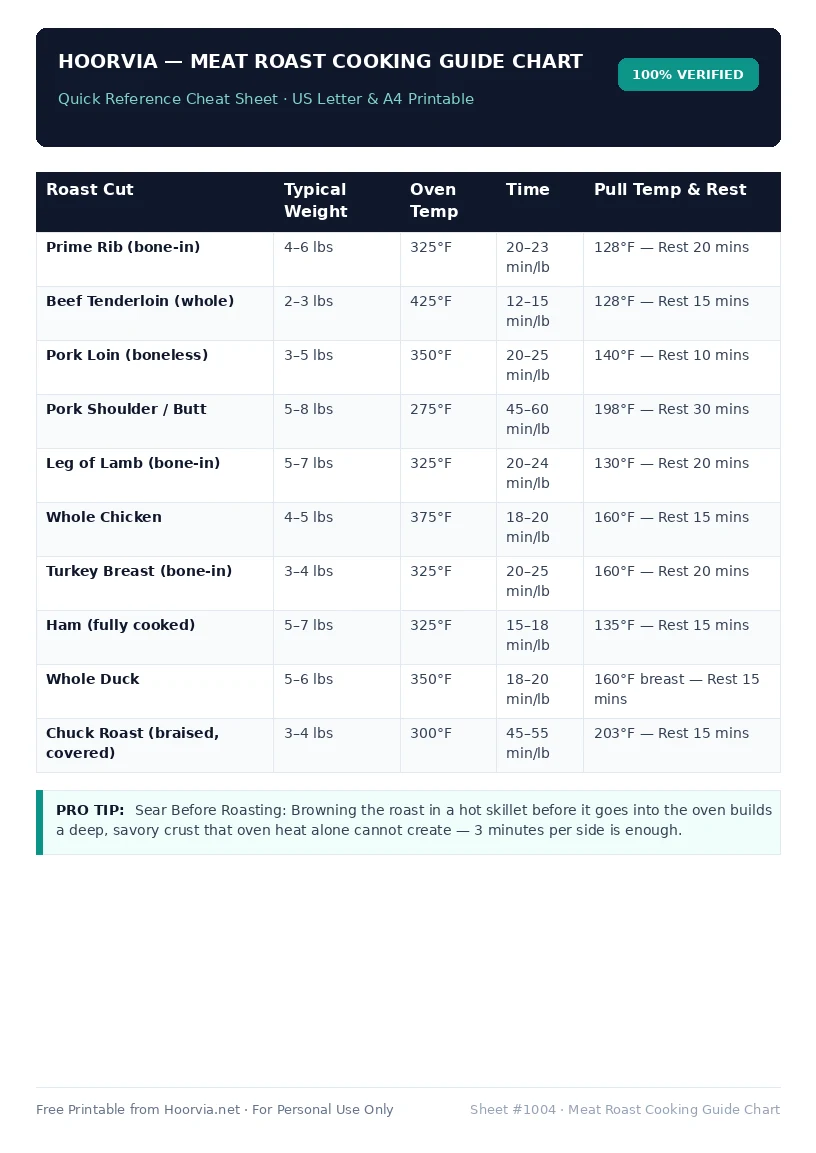
Download Your Free Printable Sheet
Download the printable PDF below. It is the same sheet shown in the preview above, ready to print on US Letter or A4 — open it and choose Print, with Scale set to Fit to Page.
💡 Pro Printing Tip: In your printer settings, set Scale to “Fit to Printable Area” and enable “Background Graphics” for color headers.