Cricut Heat Press Temperature Chart
Cricut heat press settings for HTV on cotton, polyester, blends, mugs and hats — temperature, time and pressure in one sheet.
Cricut projects fail when heat, time or pressure is wrong for the material. This chart gives starting settings for the most common iron-on (HTV) and Infusible Ink blanks, in Fahrenheit and Celsius, so you can press with confidence. Always test on a scrap piece first, because machines and vinyl brands vary.
Quick-Reference Table
The full data from this cheat sheet, right on the page.
| Material / Blank | Temp F / C | Time | Pressure / Peel |
|---|---|---|---|
| Everyday Iron-On on cotton | 315°F / 157°C | 30 sec | Firm; warm peel |
| Everyday Iron-On on polyester | 315°F / 157°C | 30 sec | Firm; warm peel |
| Everyday Iron-On on cotton/poly blend | 315°F / 157°C | 30 sec | Firm; warm peel |
| Glitter Iron-On on cotton | 330°F / 166°C | 30 sec | Firm; cool peel |
| Holographic Iron-On | 330°F / 166°C | 30 sec | Firm; cool peel |
| SportFlex Iron-On (activewear) | 305°F / 152°C | 30 sec | Firm; warm peel |
| Foiled Iron-On | 310°F / 154°C | 20 sec | Light; cool peel |
| Patterned Iron-On | 340°F / 171°C | 30 sec | Firm; warm peel |
| Infusible Ink on T-shirt (poly blend) | 385°F / 196°C | 40 sec | Light; cool peel, handle with gloves |
| Infusible Ink on coaster (ceramic) | 400°F / 204°C | 240 sec | Light; cool peel |
| Infusible Ink on mug (Mug Press) | Follow Mug Press preset | ~360 sec | Use Mug Press cycle, not a flat press |
| Hat (EasyPress on cap) | 320°F / 160°C | 30 sec | Firm with hat form; warm peel |
| Tote bag (canvas) | 315°F / 157°C | 30 sec | Firm; warm peel; press inside seams flat |
| Wood sign (HTV) | 300°F / 149°C | 40 sec | Medium; cool peel; seal after |
Printable Sheet Preview
High-Contrast Layout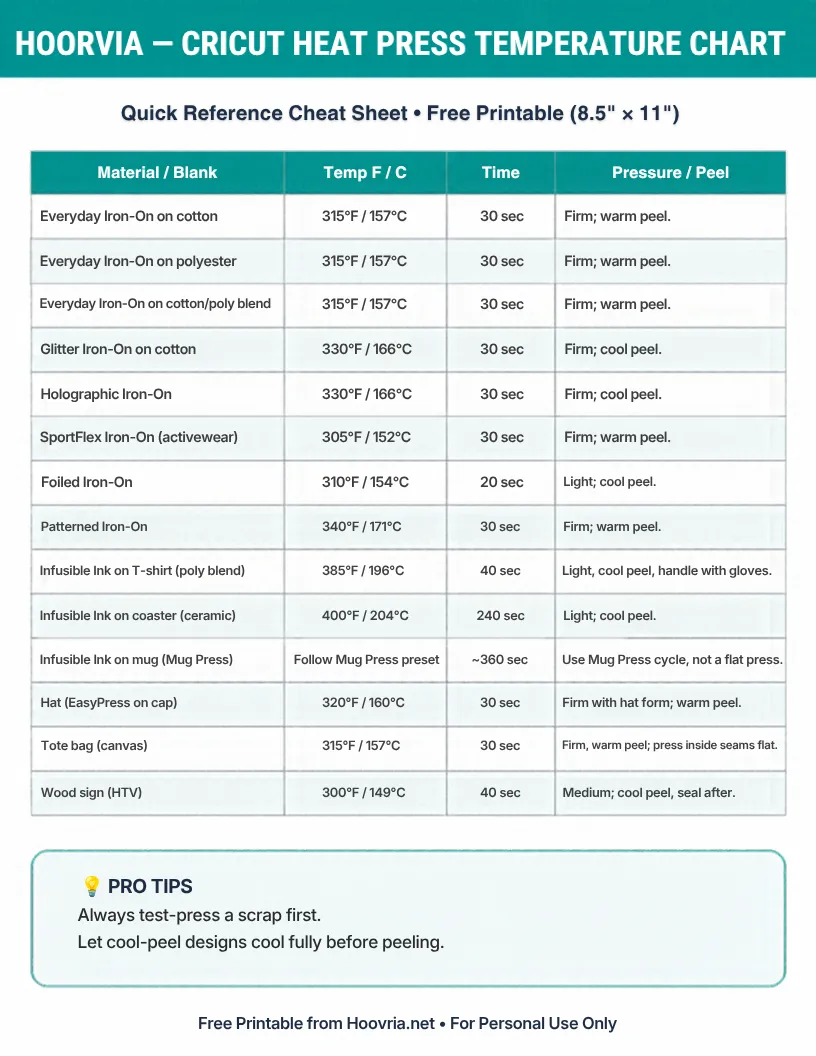
Download Your Free Printable Sheet
Download the printable PDF below. It is the same sheet shown in the preview above, ready to print on US Letter or A4 — open it and choose Print, with Scale set to Fit to Page.
💡 Pro Printing Tip: In your printer settings, set Scale to “Fit to Printable Area” and enable “Background Graphics” for color headers.
How to Print & Use This Chart
Print on US Letter or A4 and hang it above or beside your heat press, where you can glance at it while the press heats up. Choose “Save as PDF” in the print dialog for a PDF copy and set Letter or A4 to suit your printer. Because craft rooms collect vinyl scraps, dust and heat, laminate this sheet or put it in a sleeve — it will stay readable far longer than plain paper pinned to a wall. If you use both an EasyPress and a Mug Press, keep this chart with the flat press and write your Mug Press cycle notes in the margin.
Before any real project, press a test cut on a scrap of the same fabric. Preheat the blank for 5 seconds to remove moisture and wrinkles, place the design, cover with a Teflon sheet or parchment, and press with steady, even pressure — do not slide the press, which smears vinyl. Peel exactly as the chart says: warm peel means wait a few seconds, cool peel means wait until it is fully cool, or glitter and foil will lift. If edges lift after washing, the usual cause is too little pressure or too short a time, not a faulty vinyl. Wash finished items inside out in cold water and hang to dry; tumble drying shortens the life of iron-on designs. Note your winning settings per vinyl brand on the sheet, because brands differ even when the material name is the same.
Frequently Asked Questions (FAQs)
Why is my vinyl peeling after washing?▼
Usually pressure was too light, time too short, or the item was washed hot. Re-press with a Teflon sheet, wash cold, inside out, and hang dry.
Warm peel vs cool peel — what is the difference?▼
Warm peel: peel a few seconds after pressing. Cool peel: wait until completely cool. Peeling glitter or foil too early lifts the design.
Can I use a home iron instead of a heat press?▼
Yes for small designs, with firm pressure and no steam, but a press gives even heat and pressure that an iron cannot match on large designs.
Do I need a Teflon sheet?▼
Recommended. It protects the press platen and the design, and prevents scorching light fabrics.