Puppy Potty Training Schedule Printable
A puppy potty training schedule by age, with a daily log for potty breaks, accidents, meals and crate time.
Potty training works on routine, not punishment. This schedule gives age-based guidance for how often a puppy needs out, plus a daily log for breaks, successes, accidents and meals, so you can spot the pattern — usually after eating, playing, sleeping and drinking — and get ahead of it.
Quick-Reference Table
The full data from this cheat sheet, right on the page.
| Puppy age | Max time between breaks (guide) | Typical breaks per day | Key times to go out |
|---|---|---|---|
| 8–10 weeks | About 1–2 hours | 10–12+ | After waking, eating, playing, drinking; before bed |
| 2–3 months | About 2–3 hours | 8–10 | After waking, eating, playing; every 2 hours |
| 4–5 months | About 4–5 hours | 6–8 | Morning, after meals, after play, evening |
| 6+ months | About 6 hours (max, daytime) | 4–6 | Morning, midday, evening, before bed |
Printable Sheet Preview
High-Contrast Layout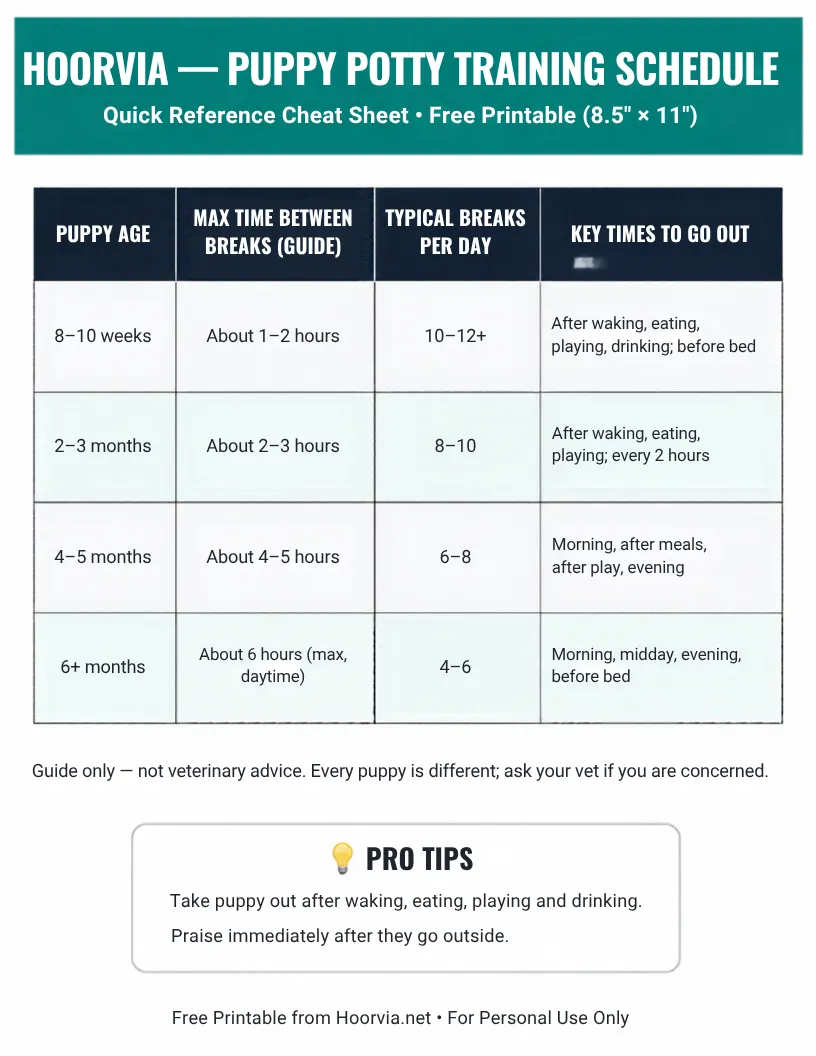
Download Your Free Printable Sheet
Download the printable PDF below. It is the same sheet shown in the preview above, ready to print on US Letter or A4 — open it and choose Print, with Scale set to Fit to Page.
💡 Pro Printing Tip: In your printer settings, set Scale to “Fit to Printable Area” and enable “Background Graphics” for color headers.
How to Print & Use This Chart
Print on US Letter or A4 and put it by the back door, where everyone in the household sees it before letting the puppy out. Choose “Save as PDF” in the print dialog for a PDF copy in Letter or A4, and laminate the schedule page if it will live near a door that gets muddy paws and rain. Print the daily log fresh each day for the first few weeks, or laminate one log and use a dry-erase marker, keeping a paper copy each week to review progress. A schedule on the door only works if every person follows the same routine, so agree the times together before you start.
Take the puppy out first thing, after every meal, after play, after a nap, after drinking, and last thing at night — and praise and reward immediately outside, not after coming back in, so the puppy connects the reward to the right place. If an accident happens indoors, clean it thoroughly with an enzymatic cleaner (ordinary cleaners often leave a scent the puppy can still smell) and do not scold after the fact; the puppy will not connect a late reaction to the accident. Watch for circling, sniffing and squatting as early signals, and keep a consistent feeding schedule, because predictable meals make predictable potty times. If accidents suddenly increase, or you see blood, straining or very frequent urination, contact your vet — it can be a medical issue, not just training. Be patient: most puppies take several months to be reliably trained, and setbacks during teething, moving house or routine changes are normal.
Frequently Asked Questions (FAQs)
How long can my puppy hold it?▼
A common guide is age in months plus one hour, up to about 6 hours in daytime for older puppies. Younger puppies need out every 1–2 hours.
Should I punish accidents?▼
No. Clean up calmly with an enzymatic cleaner and watch for earlier signals next time. Punishment after the fact does not teach, and can make a puppy hide to toilet.
When should I take my puppy out?▼
First thing, after meals, after play, after naps, after drinking, and before bed — plus every 1–2 hours for very young puppies.
My puppy was trained, now has accidents again — why?▼
Setbacks are common with routine changes, teething, or illness. Return to a stricter schedule and ask your vet if accidents are frequent or accompanied by other symptoms.