Baking Temperature Chart & Oven Heat Guide
Every baked good relies on a specific thermal window where leavening gases expand before egg and gluten proteins set. Use this oven temperature guide along with pan-material adjustments.
| Oven Heat Zone | Fahrenheit (°F) | Celsius (°C / Fan) | Gas Mark | Classic Baking Applications |
|---|---|---|---|---|
| Very Cool / Slow | 225°F – 275°F | 110°C – 135°C (95–115 Fan) | 1/2 – 1 | Meringues, pavlova, drying herbs, dehydrating |
| Slow / Low Bake | 300°F – 325°F | 150°C – 165°C (130–145 Fan) | 2 – 3 | Cheesecakes, rich fruitcakes, custards, shortbread |
| Moderate (Standard) | 350°F | 175°C – 180°C (160 Fan) | 4 | Layer cakes, muffins, quick breads, brownies, cookies |
| Moderately Hot | 375°F – 400°F | 190°C – 200°C (170–180 Fan) | 5 – 6 | Fruit pies, puff pastry, scones, yeast dinner rolls |
| Hot Oven | 425°F – 450°F | 220°C – 230°C (200–210 Fan) | 7 – 8 | Artisan sourdough, pizza crust, popovers, choux |
| Very Hot / Broil | 475°F – 500°F | 245°C – 260°C (225–240 Fan) | 9 – 10 | Neapolitan flatbreads, initial high-heat bread oven spring |
| Baked Good Type | Recommended Oven Temp | Avg Bake Time | Internal Pull Temp / Doneness Cue |
|---|---|---|---|
| Sponge & Butter Layer Cakes | 350°F / 175°C | 25–32 min | 200°F–205°F (93°C–96°C) • Crumbs cling lightly |
| Dense Pound Cake & Bundt | 325°F / 165°C | 55–70 min | 210°F (99°C) • Skewer comes out clean |
| Fudgy Brownies | 325°F–350°F / 165°C–175°C | 25–30 min | 190°F–195°F (88°C–90°C) • Moist fudgy crumbs |
| Drop Cookies (Choc Chip) | 350°F–375°F / 175°C–190°C | 9–12 min | 175°F–185°F • Golden edges, pale soft centers |
| Banana Bread & Muffins | 350°F / 175°C | 50–60 min (Loaf) | 200°F–205°F (93°C–96°C) • Firm center springback |
| Soft Enriched Sandwich Bread | 350°F–375°F / 175°C–190°C | 30–38 min | 190°F (88°C) • Hollow thump on bottom crust |
| Crusty Lean Sourdough / Baguette | 450°F / 230°C | 30–40 min | 205°F–210°F (96°C–99°C) • Deep blistered crust |
| Baked Cheesecake (Water Bath) | 325°F / 165°C | 55–65 min | 150°F (66°C) • Outer ring set, 2-inch center jiggle |
| Baking Condition / Pan Type | Temp Adjustment | Time Adjustment | Why Adjustment Is Required |
|---|---|---|---|
| Light Anodized Aluminum Pan | 0°F (Standard) | Standard Time | Reflects radiant heat evenly; gold standard for cakes |
| Dark Non-Stick Metal Pan | Reduce by -25°F (-15°C) | Check 5 min early | Dark coatings absorb radiant heat fast & burn edges |
| Glass (Pyrex) or Ceramic Dish | Reduce by -25°F (-15°C) | Add +5 to 10 min | Glass is an insulator; holds intense heat once hot |
| Convection / Fan-Assisted Oven | Reduce by -25°F (-15°C) | Check 15% early | Moving air strips away boundary layer & browns faster |
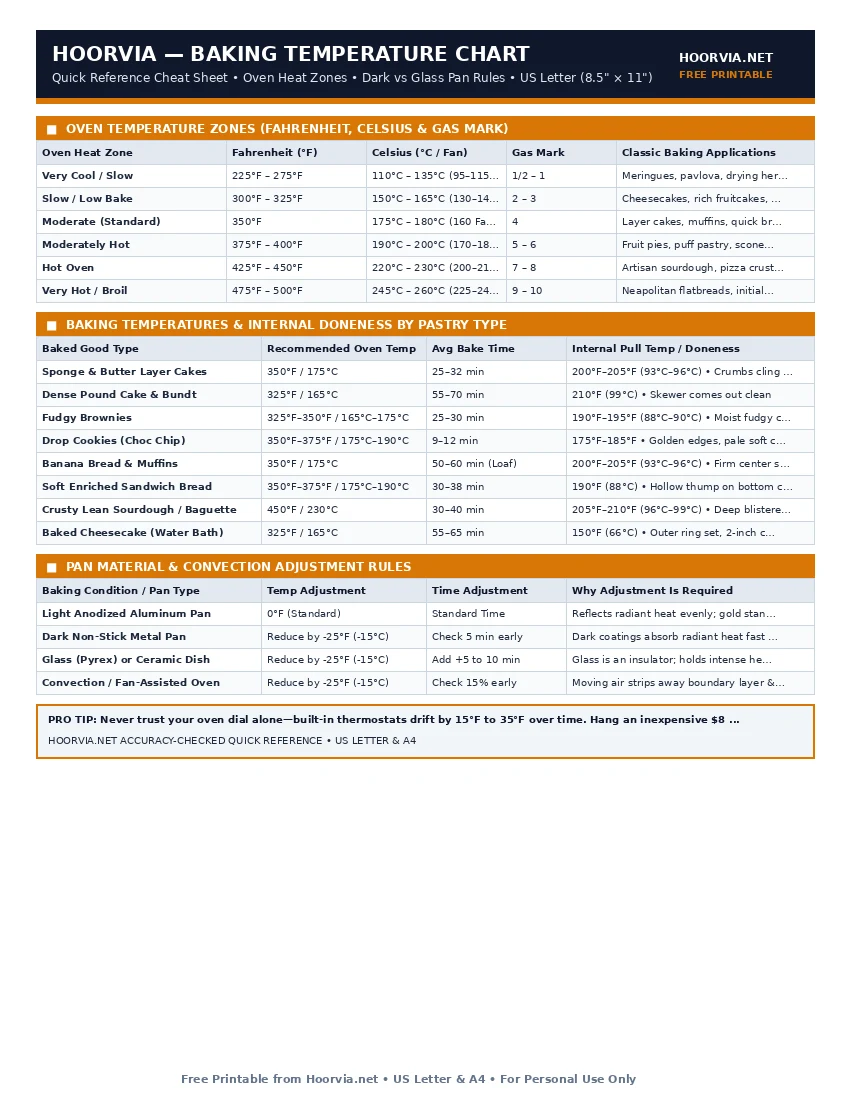
Printable Cheat Sheet Preview (US Letter & A4)
High-contrast, ink-saving layout designed for kitchen binders and refrigerator magnets. No sign-up required.
Why Pan Material & Rack Position Make or Break Your Bake
Shiny silver aluminum reflects infrared radiation from the oven walls, allowing the batter to rise level. Dark grey non-stick pans absorb heat rapidly, cooking the outer 1 inch of batter before the center warms up. Pull fudgy brownies at 190°F, quick breads and layer cakes at 200°F–205°F, and crusty yeast loaves at 208°F–210°F.
Frequently Asked Questions
Why did my cake dome and crack down the center?
Your oven temperature was too high (or you used a dark pan at 350°F). Lower heat by 25°F.
Which oven rack should I use for baking cookies and cakes?
Always use the dead-center rack (middle position) for single-pan baking so hot air circulates evenly above and below the pan.
Complete Baking & Pastry Reference Cluster (10 Free Sheets)
- 📄 Baking Ingredient Substitutions Cheat Sheet (#011)
- 📄 Baking Pan Size & Volume Conversion Chart (#013)
- 📄 Cake Pan Batter, Yield & Tier Serving Chart (#014)
- 📄 Cookie Baking Time, Temp & Scoop Size Chart (#015)
- 📄 Bread Internal Temperature & Doneness Guide (#016)
- 📄 Yeast Conversion Chart (Instant, Active & Fresh) (#017)
- 📄 Flour Weight & Protein Conversion Chart (#018)
- 📄 Sugar & Liquid Sweetener Conversion Chart (#019)
- 📄 Baking Troubleshooting Diagnostic Chart (#020)