Baking Troubleshooting Chart (Cakes, Cookies & Bread)
Baking is applied chemistry: every flopped cake, flat cookie puddle, or dense loaf leaves behind clear physical clues. Use this diagnostic matrix to match what went wrong to its scientific cause and fix.
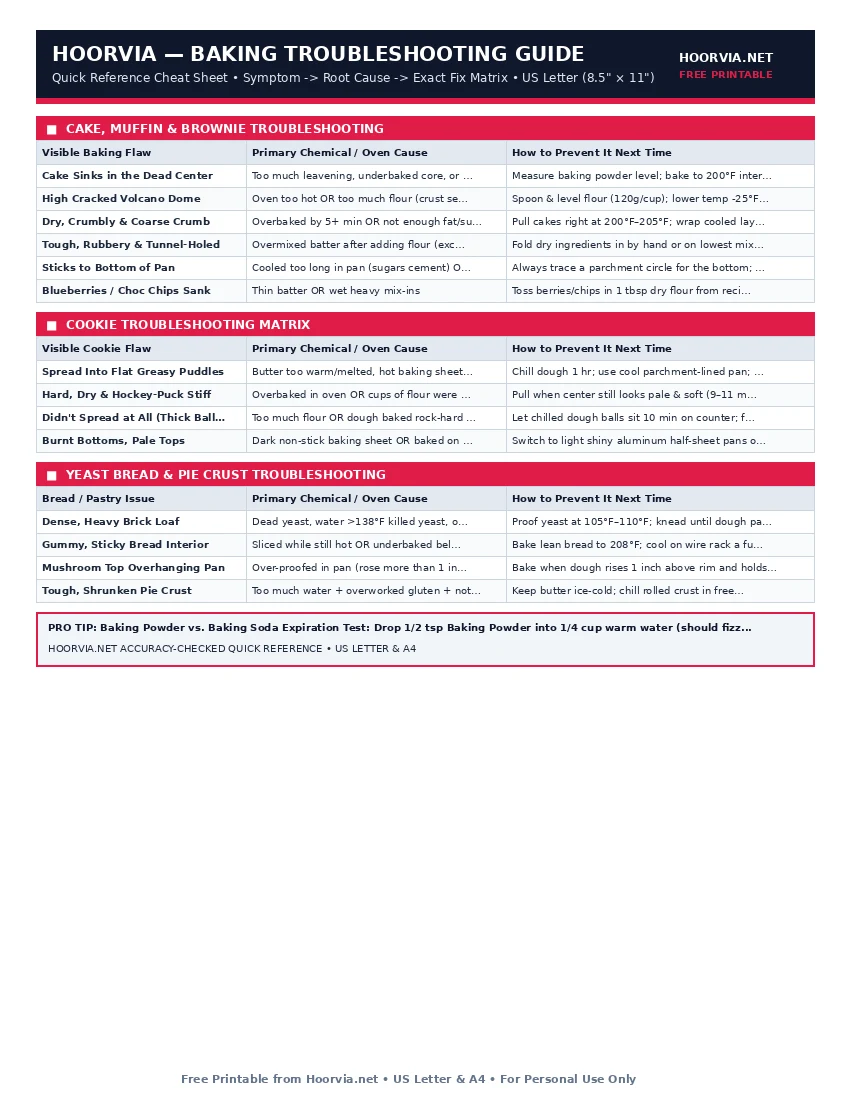
| Visible Baking Flaw | Primary Chemical / Oven Cause | How to Prevent It Next Time |
|---|---|---|
| Cake Sinks in the Dead Center | Too much leavening, underbaked core, or oven door opened early | Measure baking powder level; bake to 200°F internal; don't peek before 25 min |
| High Cracked Volcano Dome | Oven too hot OR too much flour (crust sets before center rises) | Spoon & level flour (120g/cup); lower temp -25°F; use wet cake strips |
| Dry, Crumbly & Coarse Crumb | Overbaked by 5+ min OR not enough fat/sugar | Pull cakes right at 200°F–205°F; wrap cooled layers in plastic wrap |
| Tough, Rubbery & Tunnel-Holed | Overmixed batter after adding flour (excess gluten developed) | Fold dry ingredients in by hand or on lowest mixer speed just until combined |
| Sticks to Bottom of Pan | Cooled too long in pan (sugars cement) OR un-parchmented bottom | Always trace a parchment circle for the bottom; invert after 10–12 min rest |
| Blueberries / Choc Chips Sank | Thin batter OR wet heavy mix-ins | Toss berries/chips in 1 tbsp dry flour from recipe before folding in |
| Visible Cookie Flaw | Primary Chemical / Oven Cause | How to Prevent It Next Time |
|---|---|---|
| Spread Into Flat Greasy Puddles | Butter too warm/melted, hot baking sheet, or too little flour | Chill dough 1 hr; use cool parchment-lined pan; add 2 tbsp flour |
| Hard, Dry & Hockey-Puck Stiff | Overbaked in oven OR cups of flour were dipped & packed | Pull when center still looks pale & soft (9–11 min); weigh flour at 120g/cup |
| Didn't Spread at All (Thick Balls) | Too much flour OR dough baked rock-hard straight from fridge | Let chilled dough balls sit 10 min on counter; flatten tops slightly |
| Burnt Bottoms, Pale Tops | Dark non-stick baking sheet OR baked on bottom oven rack | Switch to light shiny aluminum half-sheet pans on the middle rack |
| Bread / Pastry Issue | Primary Chemical / Oven Cause | How to Prevent It Next Time |
|---|---|---|
| Dense, Heavy Brick Loaf | Dead yeast, water >138°F killed yeast, or under-kneaded gluten | Proof yeast at 105°F–110°F; knead until dough passes the 'windowpane test' |
| Gummy, Sticky Bread Interior | Sliced while still hot OR underbaked below 195°F | Bake lean bread to 208°F; cool on wire rack a full 90 minutes before cutting |
| Mushroom Top Overhanging Pan | Over-proofed in pan (rose more than 1 inch above rim) | Bake when dough rises 1 inch above rim and holds a gentle finger dent |
| Tough, Shrunken Pie Crust | Too much water + overworked gluten + not rested before baking | Keep butter ice-cold; chill rolled crust in freezer 20 min before blind-baking |
💡 Chef's Pro Tip: Baking Powder vs. Baking Soda Expiration Test: Drop 1/2 tsp Baking Powder into 1/4 cup warm water (should fizz). Drop 1/4 tsp Baking Soda into 2 tbsp vinegar (should erupt).
Printable Cheat Sheet Preview (US Letter & A4)
High-contrast, ink-saving layout designed for kitchen binders and refrigerator magnets. No sign-up required.
The 3 Pillars of Baking Chemistry: Ratio, Temperature & Mixing
Room-temperature butter means 65°F–68°F (cool to the touch). Cream butter and sugar well, then mix flour gently just until combined.
Frequently Asked Questions
Why did my cheesecake crack down the middle?
Bake in a water bath to 150°F, turn the oven OFF, crack the oven door 2 inches, and let it cool inside for 1 hour.
Can I salvage a cake that came out slightly dry?
Poke tiny holes across the top with a toothpick and brush generously with simple syrup.
Complete Baking & Pastry Reference Cluster (10 Free Sheets)
- 📄 Baking Ingredient Substitutions Cheat Sheet (#011)
- 📄 Baking Temperature Chart & Oven Heat Zones (#012)
- 📄 Baking Pan Size & Volume Conversion Chart (#013)
- 📄 Cake Pan Batter, Yield & Tier Serving Chart (#014)
- 📄 Cookie Baking Time, Temp & Scoop Size Chart (#015)
- 📄 Bread Internal Temperature & Doneness Guide (#016)
- 📄 Yeast Conversion Chart (Instant, Active & Fresh) (#017)
- 📄 Flour Weight & Protein Conversion Chart (#018)
- 📄 Sugar & Liquid Sweetener Conversion Chart (#019)